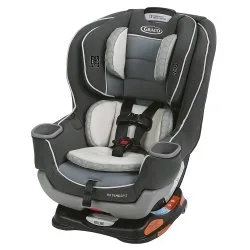
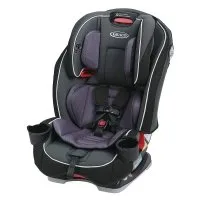
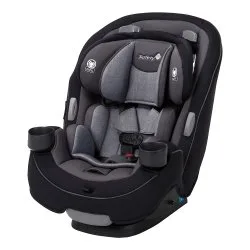
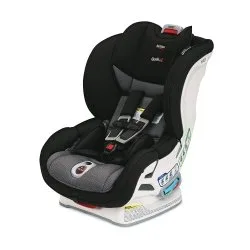
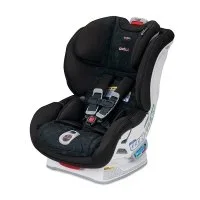
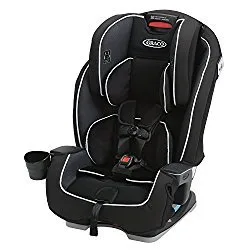
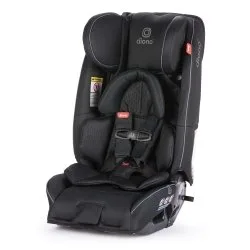
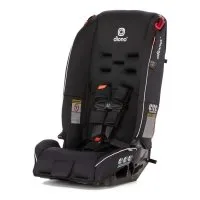
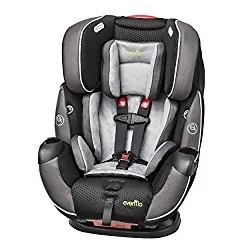
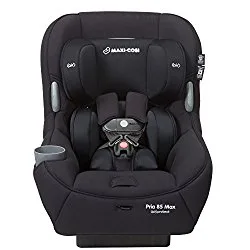
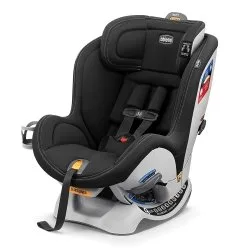
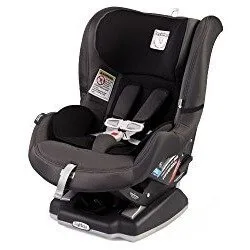
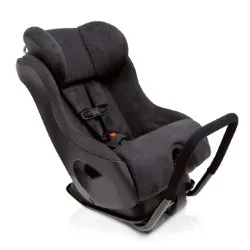
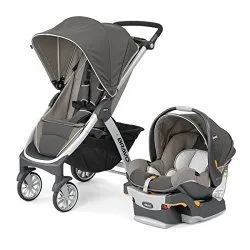
Let’s touch on some questions about convertible car seats that many parents ask

We’ll dive into some more details at the bottom of the page.
- What is a convertible car seat? Simply stated, it’s a car seat that converts to several different modes to accommodate a growing child depending on his/her weight and height. Some convertibles are listed as 3-in-1 or 4-in-1 or All-in-one models. They all start in a rear-facing mode for your infant, then convert to a forward-facing harnessed seat for your toddler. Some will also convert to a harnessed or belt-positioning highback booster seat or even a backless booster seat.
- What's the safest convertible car seat? All car seats sold in the US must meet stringent Federal and ASTM safety regulations. Most seats well exceed those standards, so every seat in our rankings will be “safe”, but ONLY if used correctly. A whopping 70% or more of seats aren’t used correctly. So, we strongly feel that the safest seats are those that are the EASIEST to install and use daily.
- Do any convertible car seats have bases? The short answer is no. You may be able to find third-party vendors still selling a couple of seats such as the Graco SmartSeat or the Orbit Baby G3, which did have bases, but those have been discontinued. We wouldn’t recommend purchasing these, as the manufacturer may not update you about recalls, have available replacement parts, etc. Convertibles are meant to stay in the car so their base is built into the seat.
- When should I switch to a convertible car seat? If you have an infant seat, and your child has outgrown the weight or height limit, it is the perfect time to switch to a convertible to allow for extended rear-facing or if she’s ready for forward-facing.
- Can you use a convertible seat for a newborn? You can, though keep in mind that the AAP and several child safety experts recommend a dedicated infant seat for newborns up to 8 pounds or more. Convertible seats tend to be roomier, so they may not offer a snug enough fit for a very small baby or preemie. Otherwise, if your baby isn’t super small, a convertible seat should fit her just fine.
Best Rated Infant (Rear-Facing Only) Car Seats

> Though a convertible seat can grow with your child longer, many safety experts recommend starting with an infant seat as opposed to a convertible. They’re **designed specifically to support newborns and very small babies** and tend to have a snugger fit with better-fitting harnesses than some convertibles.
>
> It is so critical to have a quality car seat for your newborn that the hospital will even send a nurse to your car to check the seat and make sure that it is installed properly. Simply put, if there is one thing to “splurge” on, it isn’t a cute outfit or a fancy crib – it’s the car seat.
>
> Ideally, you want to find an infant seat that provides comfort and safety for your child while still fitting into your budget. Choosing the right one isn’t always easy, so we strive to provide updated, easy-to-read, accurate information that can simplify your search.
The best infant car seat reviews present a well-rounded look at all facets of car seats, including what’s great and not so great about them. We study several characteristics of each product to get a thorough review so you can save time and money while still getting the best seat for your baby. For each product listed, we determine our rating and review on questions most parents have while shopping for a quality seat.
- Which car seats provide the safest ride?
- Which are the most comfortable (for both baby and parents)?
- Which are the most user-friendly in terms of installation and daily use?
- Which have the highest weight and height limits to allow for extended rear-facing?
- Which provide the most value for the money?
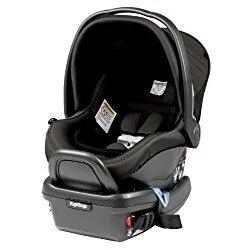
Technology is quickly advancing everywhere, including the safety seat market. Car seats have come a long way in the last few years and can accommodate a wider range of ages and sizes. Keep in mind that the AAP now recommends keeping children rear-facing for as long as possible up to the 4th birthday. So, look for infant seats with higher rear-facing weight limits such as the Peg Perego Primo Viaggio 4/35.
With just the right car seat, it’s easier to enjoy each and every car ride with your baby, from a short grocery run to a long road trip. But would you believe that you don’t have to spend an arm and a leg for a great seat?
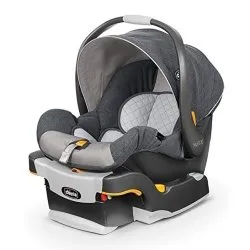
Take the Chicco KeyFit 30 for instance. It costs less than several designer models and is our highest rated seat. Discover why it’s one of our top 3 highest rated infant seats in our mini and detailed reviews.
Infant Car Seat Ratings
Go to full ratings
Below are some further considerations and information that can help guide your decision on which car seat will work best for your family.
Types of Car Seats
In the United States, the three main types of car seats available on the market are Infant, Convertible, and Booster. These seats all meet or exceed strict federal safety standards along with additional standards recommended by car manufacturers, hospitals, and parenting groups.
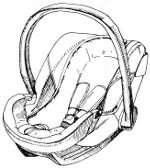
Infant: These seats are designed for infants weighing as little as 4 pounds up to 22-40 pounds, depending on the model. These seats are always used rear-facing, attach to a stationary base and have handles for carrying. The base can be moved from car to car, but the carrier is a huge convenience because it allows you to move your child around without disturbing her.
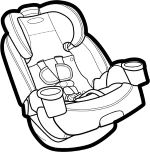
Convertible: These seats work for toddlers and babies by converting between rear-facing and forward-facing modes. Some 3-in-1 or All-in-One models also convert to belt-positioning highback booster seats or backless booster seats. Their maximum weight limit can reach 65 - 120 pounds, depending on whether they can be used as a booster.
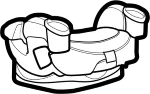
Booster Seats: Children who have outgrown a forward-facing 5-point harness seat should use a booster seat. These seats lift your child up so that the vehicle lap and shoulder belts fit them properly. There are high back and backless varieties of booster seats. A few also have the option of using a harness.
Infant vs Convertible Seat
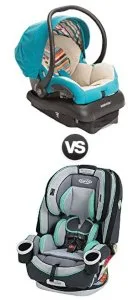
It’s just one of many questions you’ll be scratching your head about as a parent. Which one should you choose? At the end of the day, the choice is yours as to which is best for your family and budget. You should note that both types of seats have extremely safe options and both meet federal safety standards, or otherwise they wouldn’t be for sale.
The most important thing is to follow all the proper installation and weight limit guidelines so you’ll know when it’s time to change seats (or convert to a different mode). Keep your user manual handy (preferably in the car) so you can refer to it quickly. Some seats even have special compartments just to store the manual so you’ll always have it on hand, even if you’re traveling in a different vehicle.
Remember that if your child is on the higher or lower end of the growth scale for children his or her age, you have to take that into consideration when you make your purchase. Convertible seats can sometimes be too big for preemies or smaller newborns. Many parents choose to start out with an infant seat and then switch to a convertible for just that reason.
Convertible car seats tend to be more expensive, but they are versatile and can be used for a longer period of time, especially the 3-in-1 models. If you do decide to start with an infant seat, keep a close eye on the height and weight limits, which often top out at around 32 inches and 35 pounds.
Make Sure the Car Seat is Compatible With Your Car

Some cars and car seats are not compatible. Before you purchase your car seat consider what car you will use it in and where you will put it. If you have a smaller, sporty car understand that some seats will be virtually impossible to use because of the deep bucket seats. Convertible seats can be notoriously bulky and take up a lot of room. Their width could prevent you from putting two or more car seats beside one another.
The front to back length of a rear-facing seat also can seriously decrease the front seat legroom in some vehicles. If you are a tall parent keep this in mind. Some models are compact and slim to fit perfectly in small cars, but they may not have as much cushioning or accessories. Before buying, always measure your car interior and compare it to the car seat’s dimensions just to be sure it’ll fit.
Some car seats can be installed easily with the seat belt alone while some seats install easier with the LATCH and ISOFIX systems in your car. Check out our notes on installation in each of our detailed reviews to see which installation method works best. If you have a more expensive or luxury car and are worried about marking the interior, you can purchase protectors for your seats so that the upholstery stays clean and undamaged.
NOTE: Never use BOTH the seat belt and LATCH system to install a seat, except in some booster seats. Choose one or the other.
What is LATCH (Lower Anchors and Tethers for Сhildren) and ISOFIX?
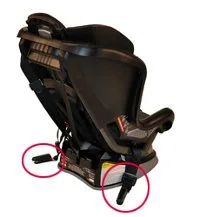
Today’s baby car seats all come with a standard attachment system that keeps them in place using built-in anchors and tethers in your car. However, most seats can still be used with the vehicle belt alone. Car seat manufacturers usually recommend using one or the other (with the exception of a booster seat). Always read your user manual or consult a local car seat technician to make sure you’re using the correct attachments.
LATCH: For any car made after the year 2001, tethers and anchors have been installed for the LATCH system (Lower Anchors and Tethers for Children). This is somewhat confusing for people used to installing with a seat belt. LATCH essentially makes it easier to install a seat properly and safely without making a mistake. With LATCH you can install your seat in any position in your car, including the middle seat.
Car manufacturers place LATCH anchors in the back seat where they can firmly anchor to the vehicle. With the LATCH system, you use the car’s built-in lower anchors and a top tether or a top strap (or the seat belt in pre-2001 cars). The top tether is a strap located above your backseat and helps secure the seat into the vehicle, making it less likely to move around if you have to make a sudden stop, sharp turn, or when you are in an accident. It also helps to keep the car seat in place on slick upholstery like leather or vinyl seats.
ISOFIX: ISOFIX is basically the same thing as LATCH, but it is called ISOFIX in Europe. The ISOFIX has a bit more rigid connector that provides a steady grip and less sideways sway than LATCH.
How do you know if a seat has been recalled?

Car seats have recalls all the time, but before you panic understand that most do not involve anything life-threatening. However, you always want to stay informed about any product recalls that involve baby products. The best way to do that is to fill out that little postage-paid registration card that came in the box with your car seat.
Most people overlook this step and just toss the registration card out with the other packaging, but that’s the only way the manufacturer can contact parents directly about any recalls. Parents should note however that you can even register most seats online now. All you’ll need is the model number, serial number and manufacture date along with your contact info.
You can also refer to the NHTSA’s website for listings of all recent car seat recalls. They update their listings frequently, so you can trust that their info is current. Alternatively, you can add your email address to their national recall notification system and be informed when any recalls are announced.
How do I know if our car seat is correctly installed?
Fire stations, pediatricians, policemen, and certified car seat technicians are trained to know what to look for in a properly installed seat. Take it to one of those experts if you’re unsure and they’ll confirm if your seat is safely installed. If not, they’ll show you how to do it right. You can also watch installation videos on YouTube for a ton of different models or check the manufacturer’s website.
How do I keep my kids from overheating and sweating while riding?

That depends on a few different factors. If you live in a hot climate or have hot summers, chances are, your baby will sweat, especially if you have to park in the sun.
- First, look for models that have breathable fabrics (we mention that in several reviews) instead of leathers.
- Consider adding sunshades to the passenger windows closest to your child to block some of the sun’s heat.
- Don’t over-dress your baby, even in winter. Coats should always come off before buckling in, or there is a risk that the safety harness won’t work properly.
- Turn on the car and AC a few minutes before putting your baby in the car seat to alleviate some of the heat in a sunny interior.
- NEVER leave your baby in the car alone, not even for just a minute. An average of 37 children tragically die each year from being left in a hot car. The interior can heat up to triple digits quickly, even on days when it’s not that hot outside. Consider some of the apps or car seat alarms that will warn you if your child is still in the car.
How and when should I dispose of a car seat?
If your seat has reached the expiration date (around 10 years for most seats), it’s time to toss it. Some stores like Target will have trade-in days where you can bring in your expired seat so they can dispose of it properly. They usually give you a discount for your next upgraded car seat.
If it’s been in a crash, unless it’s only a minor crash, it should always be thrown out. A minor crash, as defined by the NHTSA is one that meets ALL these criteria:
- You could still drive the vehicle from the crash site
- The door nearest the child safety seat was undamaged
- None of the vehicle occupants were injured
- Air bags did not deploy
- There is no visible damage to the child safety seat
If something on the seat breaks, contact the seller and ask for a refund or exchange. If you are in a car accident let your car insurance know and they can frequently help you pay for the cost of a replacement seat.
A list of most-wanted items in child safety seats
Time and again, parents have quoted these key car seat features as ones that simplify installation and make daily use of the car seats easy. Remember that ease-of-use is VERY important to maximize safety by minimizing incorrect usage.
- LATCH storage to keep unused buckles out of the way
- Harness storage (for convertible seats in booster mode)
- Owner manual storage to keep instructions close at hand
- Ease of installation with and without the seatbelt
- One handed tightening of the safety harness, preferably with a strap at the front of the seat
- Easy buckles for those with arthritis or other hand issues
Features that may be more hype than help

Remember that all car seats sold today must meet or exceed federal safety standards that involve vigorous crash testing. The most expensive car seat and the cheapest car seat both passed the same safety tests. You’ll see a lot of “side impact protection” features on many models that, while not dangerous, have not been part of any industry standardized testing. So, how much they add to the level of safety is debatable. They will NOT hurt your child, but they could hurt your wallet.
Here are a few other features you might see:
- Multi-layers of foam padding - EPS, EPP, hard, soft
- Anti-rebound bars
- Forward-facing crumple zone
- Energy-absorbing base
- Extra padded or deep head wings
Again, all of these things are good features and in certain situations can improve the safety. Just understand that there isn't any industry standard in defining how much they contribute to overall impact protection. When shopping, just keep in mind that a seat with things like anti-rebound bars or a crumple zone might cost another $50 - $100 and might not be much safer than a seat without those features.



 Our Choice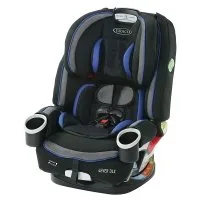
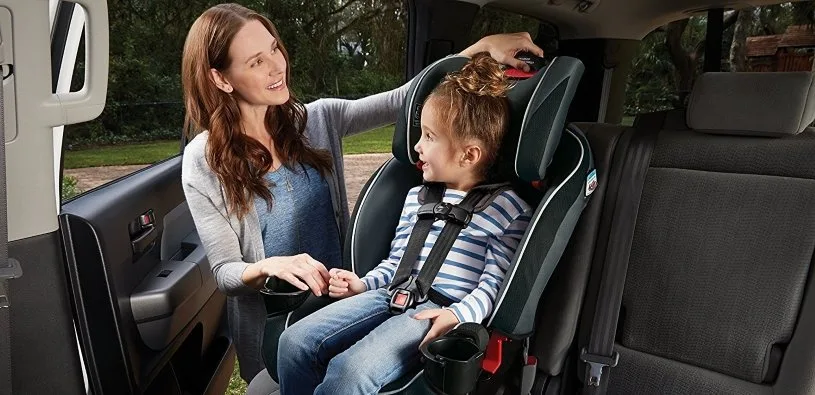
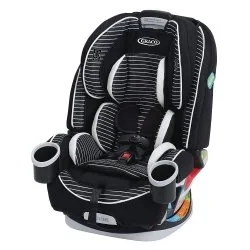
 >A convertible car seat is one of the best options for parents because they won’t have to shop for a new seat each time their child outgrows their current seat. That convenience and the overall ease of use are the main reasons why parents choose convertible models. When you see how quickly your baby grows, you will understand why convertible seats are a huge money saver. A convertible car seat begins as rear-facing and transitions into a forward-facing seat as your child grows. Some convertible models also convert into booster seats. These models take your child from infancy through elementary school and beyond all in a single car seat.