infant seat
Chicco KeyFit Max ClearTex Infant Car Seat Review
by chicco
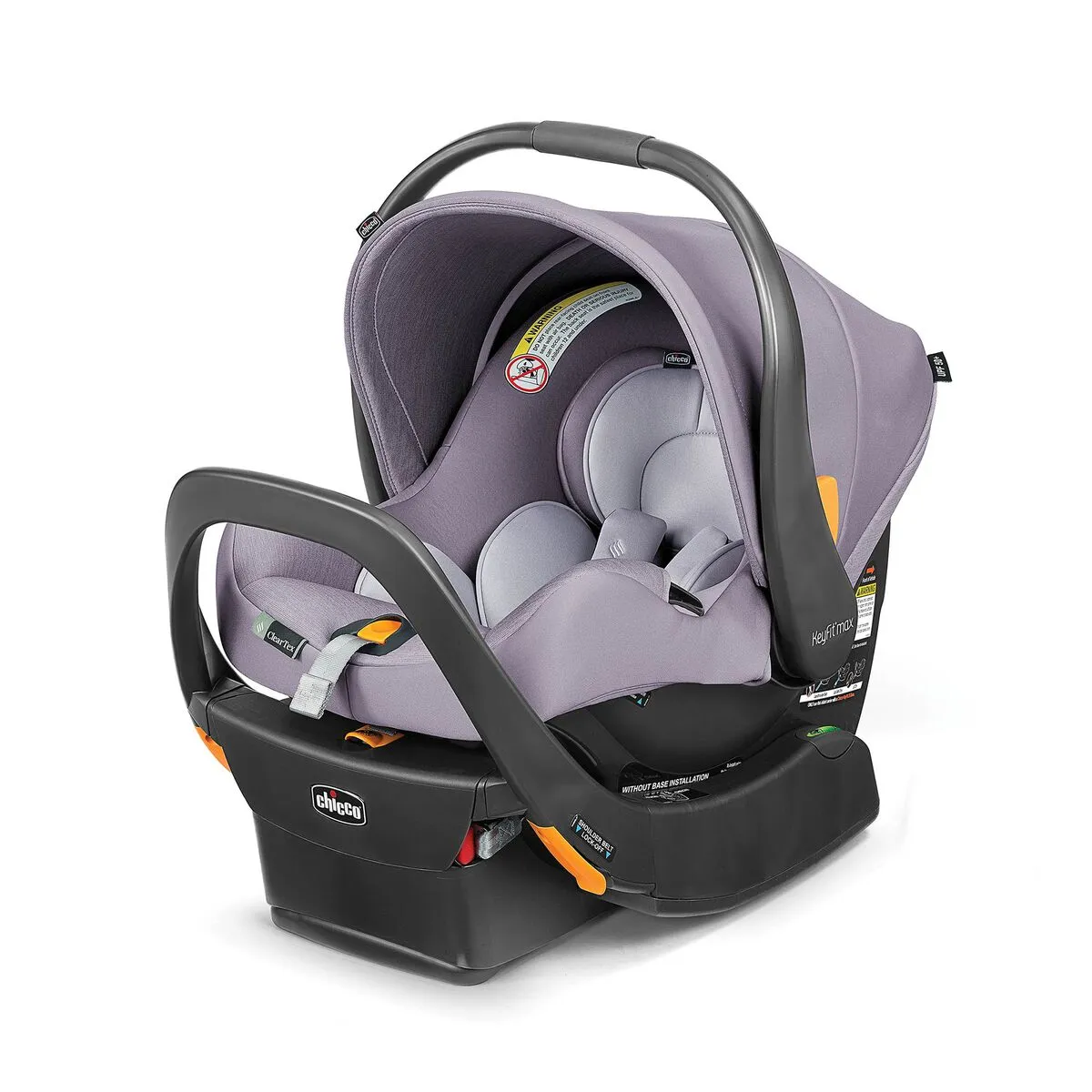
The KeyFit Max keeps the KeyFit's easy click-in base and Chicco stroller fit, and adds 2 more inches of growing room, a no-rethread harness and an anti-rebound bar, making it our pick for most parents shopping the KeyFit line.
- Rear-facing
What we like
The 32 inch height limit gives taller babies more time in the seat than the KeyFit 30, and the Easy-Extend harness moves through 5 heights without rethreading. The KeyFit Max base adds an anti-rebound bar, 6 recline positions, bubble levels and the one-pull SuperCinch LATCH tightener, so a LATCH install is quick.
It fits small babies from 4 pounds with its Newborn Positioner, installs without the base using European belt routing, and the carrier is certified for aircraft. Chicco says it meets the FMVSS 213a side-impact and 213b frontal-impact standards. The Max base also accepts KeyFit, KeyFit 30 and KeyFit 35 carriers.
Worth knowing
The weight limit is still 30 pounds, the same as the KeyFit 30 and 5 pounds less than the KeyFit 35, so a heavy baby may outgrow it by weight first. The carrier (10 lb) and base (about 8.5 lb) are heavier than the KeyFit 30's, and at 28.75 inches long it takes more front-to-back room.
Testers find the seat-belt install fiddlier than LATCH, and the harness buttons on the back of the carrier awkward. Old KeyFit 30 and KeyFit 35 bases won't work with it, and there's only one crotch-strap position. The anti-rebound bar is on the base, so you lose it in a baseless or airplane install.
❮ Back to Infant Car Seats Rating
For a lot of parents, the Chicco KeyFit is the infant car seat: the one friends hand down, and the one that clicks into a Chicco stroller without a second thought.
This page used to review the KeyFit 30. We’ve updated it for the KeyFit Max ClearTex, the current version of the KeyFit line, and kept a full comparison with the KeyFit 30 and KeyFit 35 below so you can see exactly what’s different. Every size limit on this page comes from Chicco’s current KeyFit Max owner’s manual.
Our verdict: the KeyFit Max is the KeyFit to buy for most families. It doesn’t hold a heavier baby than the KeyFit 30, but it gives you 2 more inches of height, a harness you never have to rethread, and an anti-rebound bar on the base.
Why choose an infant seat and not a convertible?
Convertible seats can rear-face and then forward-face for years, so it’s fair to ask why you’d buy a separate seat for the first year or so.
The answer is fit and convenience. An infant seat is built for small babies, and the KeyFit Max takes them from 4 pounds, with a Newborn Positioner for the smallest. In a big convertible, a tiny baby can be hard to strap in snugly. And you can lift a sleeping baby out in the carrier, click it into a stroller, and leave the base in the car.
Key features of the Chicco KeyFit Max
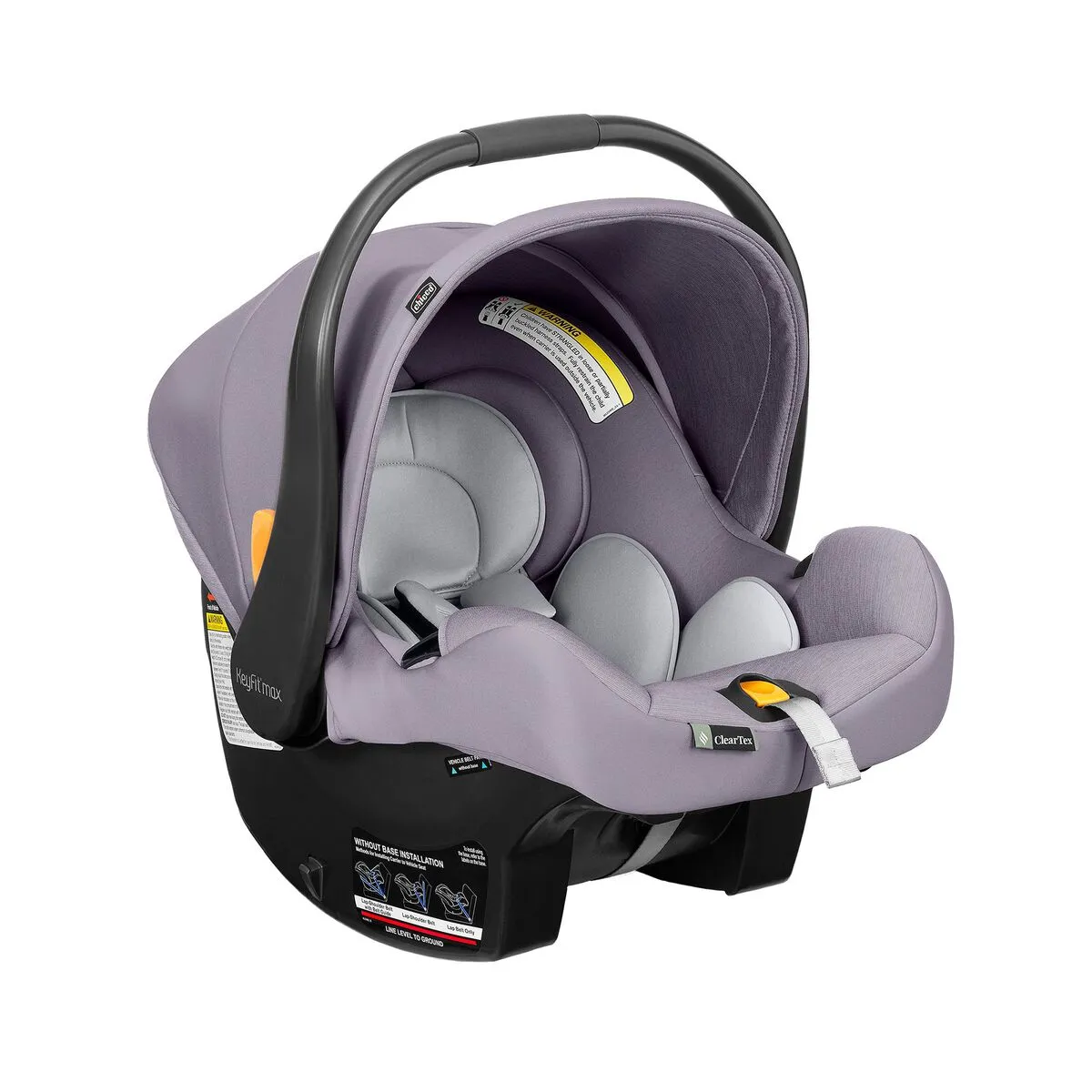
Image: Chicco
- Rear-facing from 4 to 30 lb and up to 32 inches tall
- Anti-rebound bar built into the KeyFit Max base
- Easy-Extend no-rethread harness with 5 height positions
- 6 recline positions, with the ReclineSure leveling foot and RideRight bubble levels
- SuperCinch one-pull LATCH tightener
- LockSure steel-reinforced belt lock-off for seat-belt installs
- European belt routing for installs without the base
- ClearTex fabrics, which Chicco says have no intentionally added flame-retardant chemicals
- Carrier certified for use on aircraft
What changed from the KeyFit 30 (and how the KeyFit 35 fits in)
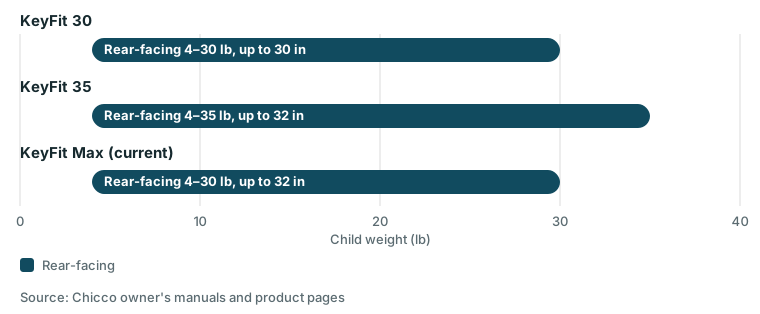
Three KeyFit models can still turn up on store shelves: the KeyFit 30, the KeyFit 35 and the KeyFit Max. (The original KeyFit stopped at 22 lb.) Here’s how they compare, according to Chicco’s manuals and product pages.
| KeyFit 30 | KeyFit 35 | KeyFit Max | |
|---|---|---|---|
| Weight limit | 4–30 lb | 4–35 lb | 4–30 lb |
| Height limit | 30 in | 32 in | 32 in |
| Harness adjustment | 3 slots, manual rethread | 5 positions, no rethread | 5 positions, no rethread |
| Anti-rebound bar | No | Yes (on base) | Yes (on base) |
| Recline positions | 5 | 6 | 6 |
| Carrier weight | 9.5 lb | 10 lb | 10 lb |
| Base weight | 7 lb | — | About 8.5 lb |
| Base takes the Max carrier? | No | No | Yes |
| Useful life | 6 years | 6 years | 6 years |
Same 30 lb weight limit, more height
This is the part parents most often get wrong, so let’s be plain: the KeyFit Max does not hold a heavier baby than the KeyFit 30. Both stop at 30 pounds.
What the Max adds is room to grow taller. The height limit goes from 30 inches to 32 inches, and most babies outgrow an infant seat by height before weight. That’s the change most likely to buy you extra months.
The other upgrades:
- No-rethread harness. On the KeyFit 30 you move the straps by unhooking and rethreading them through 3 slots. On the Max, you squeeze and slide to 5 heights.
- Anti-rebound bar on the base. Chicco says it adds stability and extended legroom.
- One more recline position (6 instead of 5).
- It’s heavier. The carrier goes from 9.5 to 10 lb, and the base from 7 to about 8.5 lb. It’s also longer front to back (28.75 inches assembled).
What about the KeyFit 35?
The KeyFit 35 holds babies up to 35 pounds, 5 pounds more than the Max. Its height limit (32 inches) is the same, and it also has an anti-rebound bar on its base and a no-rethread harness.
Chicco still lists the KeyFit 35, but it’s harder to find and being phased out at some retailers. If your baby is heavy but on the shorter side and you find a 35 in stock, it can still be the better fit.
Still shopping for the KeyFit 30?
The KeyFit 30 is still sold by Chicco, and it’s still a good seat. It’s in a slightly lower price band, it’s lighter to carry, and BabyGearLab found its seat-belt install easier than the Max’s. The trade-off is the 30-inch height limit and the rethread harness, so a tall baby will outgrow it sooner.
Can I use my old KeyFit base?
Important if you’re upgrading: your old KeyFit 30 or KeyFit 35 base will not work with a KeyFit Max carrier. The KeyFit/KeyFit 30 base is approved only for KeyFit and KeyFit 30 carriers (KeyFit 30 manual), and Chicco says the KeyFit 35 base is “NOT compatible” with the Max. Budget for a KeyFit Max base for each car.
It works the other way, though. The KeyFit Max base accepts KeyFit, KeyFit 30, KeyFit 35 and KeyFit Max carriers, according to its manual. Never use a Chicco Fit2 carrier on it.
What are the size limits of the KeyFit Max?
The KeyFit Max is rear-facing only. Per the owner’s manual, your baby can ride in it while:
- They weigh 4 to 30 pounds, and
- They’re 32 inches tall or less, and
- The top of their head is at least 1 inch below the top of the headrest.
Stop using it as soon as your baby reaches either the weight or the height limit. Use the Newborn Positioner only from 4 to 11 pounds. The Head Rest Insert is optional, with or without the positioner. The harness straps should sit at or just below your baby’s shoulders. Chicco also says to check with your doctor before using it with a premature baby.
For more on why both limits matter, see our guide to height and weight limits for rear-facing seats.
How big is it, and will it fit your car?
Chicco lists the assembled seat at about 17 inches wide and 28.75 inches long. The width is friendly for smaller back seats, and Babylist calls it narrow enough for many three-across setups. The length is the catch: it takes more front-to-back room than the KeyFit 30, so a tall front passenger may need to slide forward in a compact car.
The carrier weighs 10 pounds by Chicco’s figure (BabyGearLab measured a little more) before your baby is in it, so plan on a stroller for long walks. See our three-across guide for tight back seats.
How safe is the KeyFit Max?
Every car seat sold in the US must meet the federal standard, FMVSS 213. Chicco says the KeyFit Max also meets the side-impact standard FMVSS 213a and the frontal-impact standard FMVSS 213b. We haven’t crash-tested it ourselves.
The anti-rebound bar braces the base against the vehicle seat back. Chicco describes its benefit as added stability; it doesn’t publish a crash figure for it, so neither do we. The bar is part of the base, so a baseless or airplane install has no anti-rebound bar.
Independent testing is a useful reality check here. BabyGearLab rated the Max’s crash-sensor results “average” and gave the KeyFit 30 the same crash score, so don’t expect the Max to protect better than the 30 in a crash. On the plus side, Babylist names it one of its picks for best infant car seats and quotes a car seat technician: “It fits even the tiniest babies really well.”
Recalls: we found no open US recall for the KeyFit Max or the KeyFit 30 as of this review. (An old campaign on KeyFit/KeyFit 30 bases, NHTSA 08C007, is long closed.) You can always check your seat’s model number at nhtsa.gov/recalls.
Like every seat, it has a 6-year useful life (see the “Do Not Use After” label underneath), and you must replace it after any crash, even if you can’t see damage.
How hard is it to install?
With the base
LATCH is the easy route. Clip the lower anchor connectors on, level the base with the ReclineSure foot and bubble levels, then pull the SuperCinch strap. There’s no top tether, and you should never use LATCH and the seat belt together. The manual sets no separate lower-anchor weight limit.
Seat-belt installs are the weak spot. You route the lap-shoulder belt through the base and clamp the shoulder belt in the lock-off, so locking the vehicle belt is optional. BabyGearLab found the belt path tight and the lock-off underwhelming. If LATCH isn’t an option in your seating position, take your time, or have a certified car seat technician check your work.
Without the base
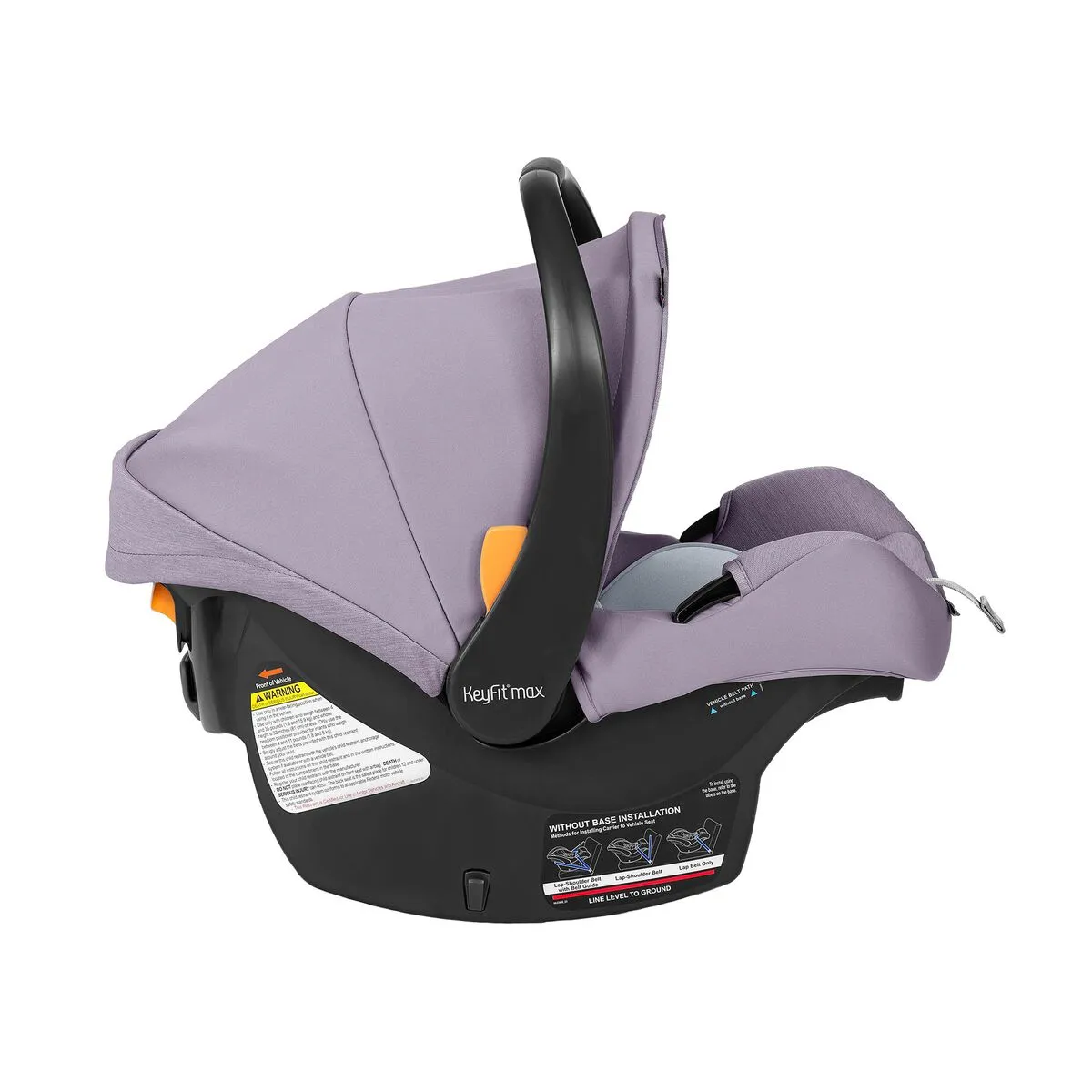
Image: Chicco
For taxis, rideshares or a second car, you can install the carrier alone with a lap-shoulder belt in locked mode, through the side belt guides. For a firmer fit, the manual shows European routing, which wraps the shoulder belt behind the carrier. Never install it without the base using a non-locking belt. If you need help getting the level line right, the manual says a tightly rolled towel may be used under the front edge of the carrier.
On an airplane
The carrier is certified for aircraft use (Chicco says it’s FAA certified). Leave the base at home, install the carrier with the plane’s lap belt, and use it only on forward-facing aircraft seats. More tips are in our airplane car seat guide.
Comfort and everyday use
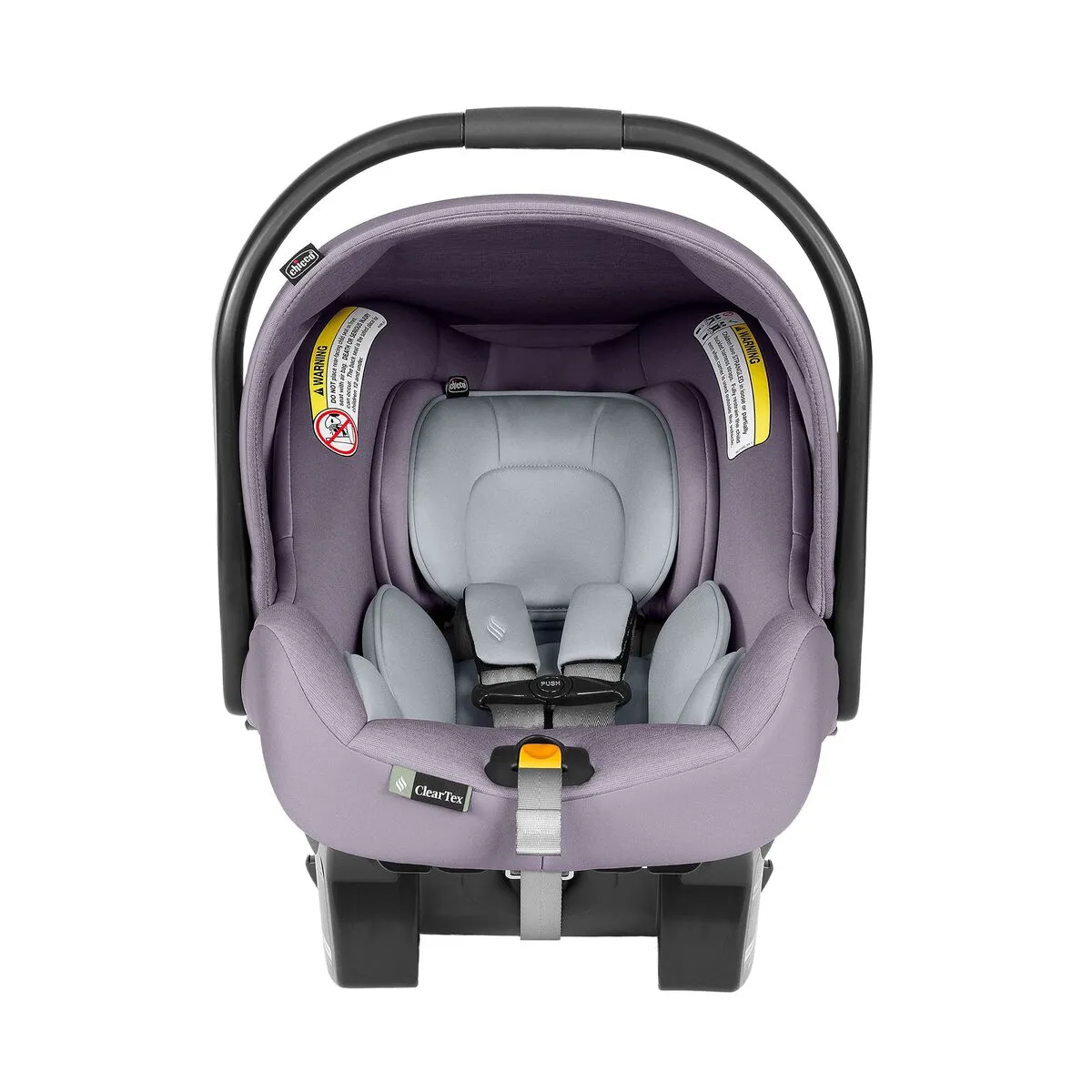
Image: Chicco
The harness is the everyday win: moving it up takes seconds instead of a rethreading session, though testers found the adjustment buttons on the back of the carrier a little awkward. The handle has three positions and must be locked in one of them in the car. The extendable UPF 50+ canopy covers well, but BabyGearLab noticed its frame can catch on the handle.
Stroller compatibility and other versions
Chicco says the KeyFit Max fits all Chicco strollers except the Liteway and Urbino, so a Chicco Bravo travel system is a natural match. Chicco doesn’t recommend other brands’ adapters, so don’t count on third-party strollers. Chicco also sells it with the modular Corso LE stroller in the Corso LE ClearTex travel system, where the carrier can face you or face forward; Chicco’s Corso LE bundle without ClearTex in its name lists the KeyFit 35 instead, so check the seat name.
Chicco also sells KeyFit Max Zip versions with a zip-off cover and premium fabric options. They’re the same core seat at a higher price.
How it compares
If the 30 lb limit is the sticking point, the KeyFit 35 (4–35 lb, up to 32 in) is the in-family option while you can still find it, though it’s being phased out at some retailers and its base won’t take the Max carrier. Check each seat’s label for its exact limits. The Graco SnugRide SnugFit DLX, once sold as the SnugFit 35 DLX, is no longer one of them: Graco now rates it 4 to 30 lb, the same as the KeyFit Max. Premium seats like the Nuna PIPA series and UPPAbaby Mesa Max add a load leg, but cost much more.
Best Car Seat Hub’s final verdict

- More growing room: 32-inch height limit, 2 inches more than the KeyFit 30
- No-rethread harness with 5 heights
- Anti-rebound bar on the base
- Easy LATCH install with bubble levels and a one-pull tightener
- Fits small babies from 4 lb, with a Newborn Positioner
- Travel-friendly: clicks into most Chicco strollers, installs without the base, and the carrier is certified for aircraft

- Same 30 lb weight limit as the KeyFit 30, and 5 lb less than the KeyFit 35
- Heavier carrier and base than the KeyFit 30
- Long front to back, which can crowd front passengers in small cars
- Seat-belt install is fiddly compared with LATCH
- Old KeyFit 30 and 35 bases won’t take it, so extra bases are a new purchase
- Only one crotch-strap position
Who it’s for
Parents who want the KeyFit’s easy click-in base and Chicco stroller fit, with the most growing room the line offers. It’s especially good if you expect a tall baby, want a harness you never have to rethread, or are starting fresh with no old KeyFit bases.
Who should skip it
- Families with a heavy but shorter baby. A 35 lb seat, like the KeyFit 35 if you can find one, may last longer.
- Parents who’ll mostly install with a seat belt. LATCH is where this seat shines.
- Anyone short on front-to-back room, or who wants a lighter carrier. The KeyFit 30 is lighter and shorter.
- Families planning to reuse a KeyFit 30 or 35 base. It won’t take the Max.
Want to see how it ranks against other infant seats? Head back to our safest infant car seats list.
- Seat type
- Rear-facing-only infant seat (carrier with stay-in-car base)
- Rear-facing
- 4–30 lb, 32 in or less; top of head at least 1 in below the top of the headrest
- Newborn Positioner
- 4–11 lb only
- Harness
- 5-position, no-rethread (Easy-Extend headrest)
- Recline
- 6 positions
- Crotch positions
- 1
- Handle positions
- 3 (must be locked in one of them in the vehicle)
- Anti-rebound bar
- On the KeyFit Max base (none when installed without the base)
- Carrier weight
- 10 lb (Chicco)
- Base weight
- About 8.5 lb (Chicco)
- Dimensions
- 28.75 in L x 17 in W x 24 in H, assembled (Chicco)
- Base fits carriers
- KeyFit, KeyFit 30, KeyFit 35, KeyFit Max (not Fit2)
- Installation
- LATCH lower anchors or lap-shoulder belt with lock-off; baseless with a locked lap-shoulder belt
- FAA
- Carrier certified for aircraft (without the base)
- Federal standard
- FMVSS 213; Chicco says it meets FMVSS 213a (side) and 213b (frontal)
- Strollers
- All Chicco strollers except the Liteway and Urbino (Chicco)
- Useful life
- 6 years (see the "Do Not Use After" label under the seat)