infant seat
Joie Rue Infant Car Seat with Base Review
by joie
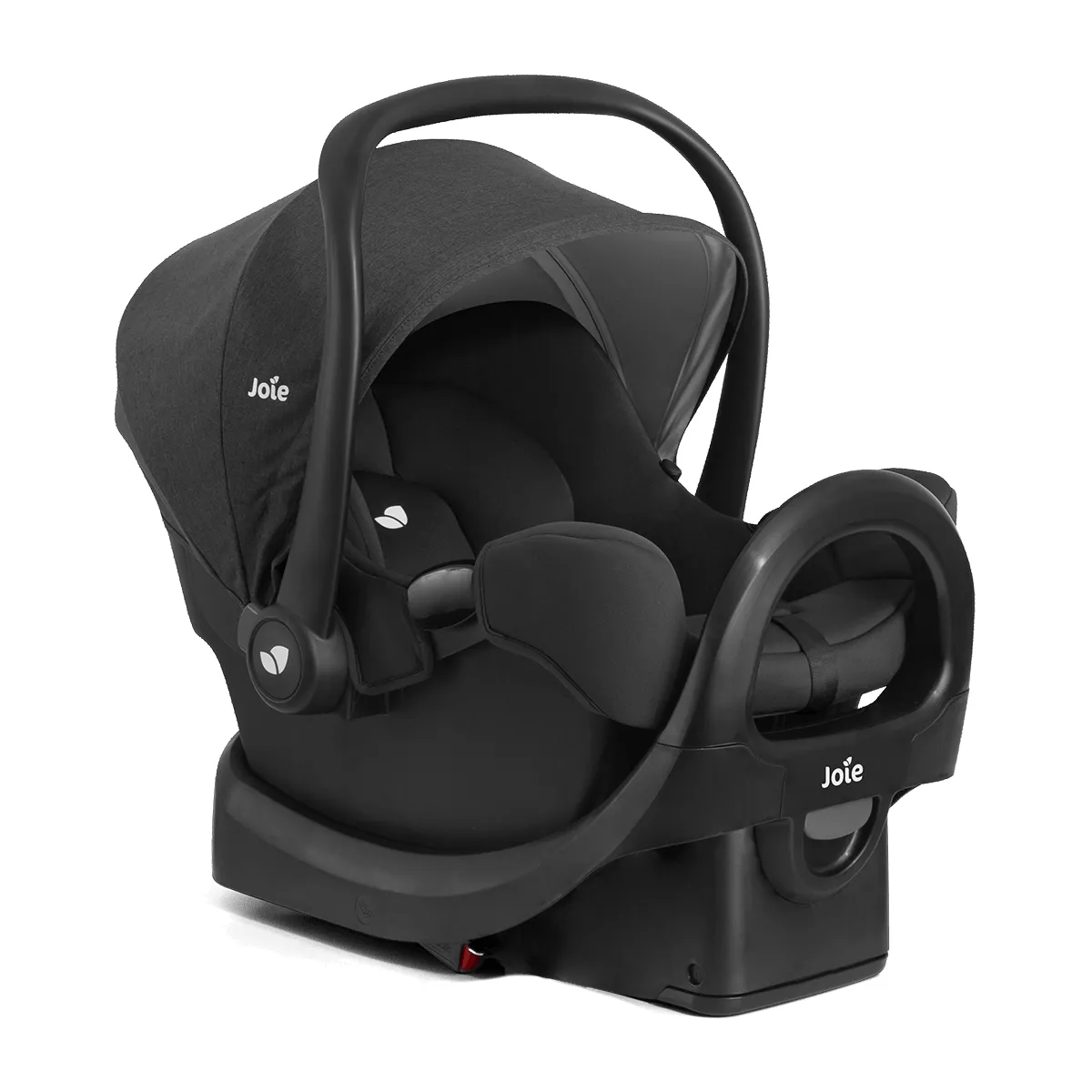
The Joie Rue is a light, low-cost infant seat with a lock-off base that installs with or without that base and is certified for airplanes, but its height limit is under 30 inches, belt installs are harder than LATCH, and it works only with Joie strollers or Joie adapters.
- Rear-facing
What we like
The light carrier (about 7.8 pounds, per Joie) is easy to carry, and the base has a lock-off and 4 recline positions. There's no separate LATCH limit, so the lower anchors work across the full 4 – 30 pound range.
The carrier installs without the base with a lap/shoulder or lap-only belt, and it's certified for aircraft without the base. Joie says it's tested to FMVSS 213a and 213b and has an anti-rebound bar in the base.
Worth knowing
The height limit is less than 30 inches, lower than 32-inch rivals, so taller babies may outgrow it sooner. Testers found belt installs harder than LATCH, and the harness has to be rethreaded by hand.
It works only with Joie strollers or Joie adapters, and its 7-year life counts from the original purchase, so keep your receipt.
❮ Back to Cheap Infant Car Seats
Looking for a light, low-cost infant seat that does the basics well? The Joie Rue deserves a look. It’s a rear-facing-only carrier and base for babies 4 to 30 pounds and less than 30 inches tall. Joie lists the carrier at about 7.8 pounds, the base has a lock-off, and the carrier also installs without its base, in a taxi or on a plane.
We built this review from Joie’s owner’s manual (IS-2024-07-11), Joie’s US product page and independent testers’ findings. We haven’t crash-tested or installed it ourselves.
Our verdict: a smart budget pick for parents who’ll mostly install with LATCH and like a Joie travel system. The trade-offs are a height limit under 30 inches, harder belt installs, a rethread harness and Joie-only stroller fit.
Who is Joie?
Joie is new to Best Car Seat Hub, and to many US parents. The Rue’s manual lists its US arm as Joie Children’s Products, Inc., in Morgantown, Pennsylvania, with a US consumer service line (1-866-798-7866). The Rue is one of several Joie infant seats. This review covers the Rue with Base only. The Rue LX and Rue LX Spin are different models with their own manuals, so don’t mix up their details with this one.
Why choose an infant seat and not a convertible?
Convertible seats last for years, but an infant seat is easier in the newborn months. You can carry a sleeping baby inside, click the carrier onto a stroller and leave the base installed in the car.
Key features of the Joie Rue
- Rear-facing from 4 to 30 lb and less than 30 inches, per Joie’s manual
- About 7.8 lb carrier (Joie); BabyGearLab measured 7.1 lb
- Stay-in-car base with a lock-off for LATCH or seat-belt installs, plus 4 recline positions
- Installs without the base with a lap/shoulder or lap-only belt
- Certified for aircraft, carrier only
- Infant insert with a low-birth-weight pillow, used until 11 lb
- Anti-rebound bar built into the base, according to Joie
- 7-year useful life, counted from the original purchase
What are the size limits?
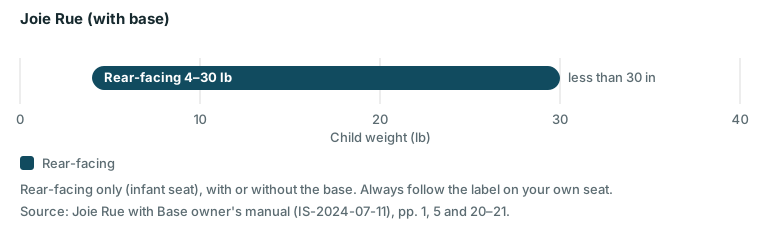
Limits from Joie’s Rue with Base manual (IS-2024-07-11). Chart: BestCarSeatHub.
The Rue is rear-facing only. The manual says, “NEVER use this child restraint forward-facing.” Your baby can ride in it while:
- They weigh 4 to 30 pounds, and
- They’re less than 30 inches tall, and
- The top of their head is at least 1 inch below the top of the seat.
Stop using it as soon as your baby reaches the weight limit or the height limit, whichever comes first. The harness straps must sit at or just below the shoulders. These limits are the same for every install method, with or without the base.
Joie’s manual adds a best-practice line: children should ride rear-facing as long as possible, until at least 2 years old. That’s advice, not a limit of this seat. When your baby outgrows the Rue, move to a rear-facing convertible. More in our guide to rear-facing height and weight limits.
Inserts for newborns
The infant insert, with a low-birth-weight pillow inside it, is for smaller babies. It must be removed once your baby reaches 11 pounds. The separate head support can stay until your baby outgrows it, but its straps go only in the top two harness slot positions, never the same slots as the harness. For a preterm baby or one under 5 pounds, Joie recommends following AAP guidance and asking your doctor or hospital before the first trip.
How big is it, and will it fit your car?
Joie lists the carrier at about 7.8 pounds and the base at about 8.7 pounds (24 x 12.5 x 15 inches). BabyGearLab weighed the carrier at 7.1 pounds. Car Seats for the Littles lists it at about 17.5 inches wide. That’s light for the class, which is the Rue’s everyday win.
The vehicle seat must face forward (no side- or rear-facing seats), and the manual rules out inflatable and door-mounted belts. Tight back row? See our three-across guide.
How safe is the Joie Rue?
Federal standards: the manual says the Rue conforms to all applicable Federal Motor Vehicle Safety Standards. Joie says the Rue is tested to FMVSS 213a (side impact) and FMVSS 213b, and lists it on its FMVSS 213a and 213b page. FMVSS 213a applies to seats made on or after December 5, 2026. That claim comes from Joie’s product page, not the manual, and we didn’t test it.
Anti-rebound bar: Joie says the base has a built-in anti-rebound bar. The manual’s parts list and install steps don’t describe one, so follow the manual for every install step.
Third-party testing: BabyGearLab’s commissioned crash tests gave the Rue lower-than-average head and chest readings for its group. That’s a tester’s result, not a federal rating.
Recalls: we found no recall when we checked (November 2026). Search your seat’s model number at nhtsa.gov/recalls and register it with Joie.
After a crash: never use the Rue after a moderate or severe crash. The manual allows reuse after a minor crash only if all five of NHTSA’s minor-crash conditions apply.
The 7-year life starts at purchase
The manual says: “DO NOT USE THIS CHILD RESTRAINT 7 YEARS AFTER ORIGINAL PURCHASE.” Most brands count from the date of manufacture, so this is unusual. Keep your receipt, and check the manufacture-date label on the seat too.
How hard is it to install?
With the base
Install the base with the lower anchors (LATCH) or the vehicle seat belt, lap/shoulder or lap-only. The manual says both are equally safe, but use only one method, never both. There’s no separate LATCH weight limit, so the lower anchors work for the full 4–30 lb range.
The lock-off closes over the LATCH strap or the vehicle belt. The manual warns not to over-tighten the LATCH strap, or the lock-off won’t close. When you’re done, the base should move less than 1 inch at the belt path. Then push the carrier down until it clicks and pull up on the handle to check it.
Set the recline first. The base has 4 recline positions and a bubble level: for babies 0–3 months, the bubble must sit entirely under the light blue line; from 3 months, under any part of it. A rolled towel is allowed if you can’t get the angle right. BabyGearLab notes that the recline button can press against the vehicle seat, so set it before you tighten.
Testers found LATCH much easier than the belt. BabyGearLab rated the LATCH install highly but found belt installs less stable. If you’ll mostly install with a seat belt, take your time, or have a certified car seat technician (CPST) check it.
Without the base
For taxis or a second car, the carrier installs alone with a locked lap/shoulder belt or a lap belt only. Keep the level line on the carrier label level with the ground.
The manual’s Option 1 (suggested) wraps the shoulder belt around the back of the carrier. Car Seats for the Littles and BabyGearLab call this European routing. Option 2 lets the shoulder belt lie against the seat back. BabyGearLab found baseless installs took more work in some cars. See our taxi and rideshare guide.
On an airplane
The manual says the Rue is certified for airplane use. On the plane, install the carrier only, without the base, rear-facing with the aircraft lap belt under both lap belt guides. Check with your airline before you travel. More in our airplane car seat guide.
Comfort and everyday use
The handle has three locked positions (Carry, Travel and Stand) and a non-locking Convenience position. Joie recommends the Carry position in the vehicle.
The harness is a rethread design: to raise the straps, you rethread them by hand. BabyGearLab called the padding basic and found the canopy and handle can bump into each other. Some Babylist owners mention unpadded straps. Car Seats for the Littles liked the clear labels and large recline range, but found the head support fiddly to reattach.
Stroller and base compatibility
The manual says: “Only use with Joie strollers or appropriate Joie adapters designed for use with other strollers.” Check that your stroller and adapter are Joie-approved before you buy. Never put the carrier on a shopping cart. See our travel system picks.
How it compares
| Joie Rue | Graco SnugRide Lite LX | Evenflo LiteMax 30 | Baby Trend EZ-Lift PLUS | |
|---|---|---|---|---|
| Limits | 4–30 lb, less than 30 in | 4–30 lb, 32 in | 3–30 lb, 32 in | 4–30 lb, 29.5 in |
| Carrier weight | About 7.8 lb (Joie) | 7.2 lb (Graco) | About 7.4 lb (Safe in the Seat) | 7.5 lb (Baby Trend) |
| Lock-off on base | Yes | No | Yes | No |
| Anti-rebound bar | Joie says yes (base) | No | No | Rebound handle position, to 22 lb |
| Harness | Rethread | Rethread | Rethread | Rethread |
| Price band | Low | Low | Low | Low |
The LiteMax 30 is still our budget favorite: it has a lock-off base too, and it gives taller babies more room at 32 inches. The SnugRide Lite LX goes to 32 inches as well, but has no lock-off. The Rue sits between them: a lock-off, Joie’s anti-rebound and side-impact claims, and a lower height limit.
Best Car Seat Hub’s final verdict

- Light carrier (about 7.8 lb, per Joie)
- Lock-off base for LATCH or belt installs, with 4 recline positions
- No separate LATCH limit across 4–30 lb
- Installs without the base, including the shoulder-belt-around-the-back option
- Certified for aircraft (carrier only)
- Joie says it’s tested to FMVSS 213a and 213b and has an anti-rebound bar in the base
- Budget price band

- Height limit is less than 30 inches, lower than 32-inch rivals
- Testers found belt installs harder than LATCH
- Rethread harness and basic padding
- Joie strollers or Joie adapters only
- 7-year life counts from purchase, so keep the receipt
Who it’s for
Budget-minded parents who want a light carrier, a lock-off base and the option to install without the base or fly with it. It suits families who’ll mostly install with LATCH and plan on a Joie stroller.
Who should skip it
- Parents of babies who run tall. A 32-inch seat like the LiteMax 30 gives more room.
- Families who’ll mostly install with a seat belt and want it to be easy. Get a CPST to check yours.
- Anyone set on another brand’s stroller without a Joie adapter.
- Parents who want a no-rethread harness or a load leg. See our safest infant car seats.
Want to see how it ranks? Head back to our best cheap infant car seats list.
Frequently asked questions
What are the Joie Rue’s weight and height limits? 4 to 30 pounds and less than 30 inches tall, rear-facing only, with the top of the head at least 1 inch below the top of the seat.
Is the Joie Rue FAA approved? Yes. The manual says it’s certified for airplane use, carrier only, without the base, with the aircraft lap belt. Check with your airline.
Can I use the Rue without the base? Yes, with a lap/shoulder belt or a lap belt only.
When do I remove the infant insert? At 11 pounds.
When does the Joie Rue expire? The manual says not to use it 7 years after original purchase. Keep your receipt.
Does the Joie Rue have an anti-rebound bar? Joie says the base has one built in. The manual doesn’t describe it.
Does the Joie Rue meet FMVSS 213a? Joie says it’s tested to FMVSS 213a and 213b. The manual says it conforms to all applicable federal standards.
- Seat type
- Rear-facing-only infant seat (carrier with stay-in-car base); never forward-facing
- Weight limit
- 4–30 lb
- Height limit
- Less than 30 in (top of the head at least 1 in below the top of the seat)
- Harness position
- At or just below the shoulders
- Infant insert
- With a low-birth-weight pillow; must come out at 11 lb
- Head support
- Use as needed; top two harness slots only
- Harness
- Rethread by hand
- Base recline
- 4 positions, with a bubble level and a recline foot
- Base install
- Lower anchors (LATCH) or vehicle belt (lap/shoulder or lap-only), never both; lock-off closes over either
- LATCH limit
- No separate limit; the manual allows LATCH across the full 4–30 lb range
- Install without the base
- Lap/shoulder belt (shoulder belt around the back of the carrier is the manual's suggested option) or lap belt only
- Handle positions
- Carry, Travel and Stand (locked) plus Convenience (non-locking); Joie recommends Carry in the vehicle
- Anti-rebound bar
- Joie says it's built into the base (not described in the manual)
- Carrier weight
- About 7.8 lb (Joie)
- Base
- About 8.7 lb; 24 x 12.5 x 15 in (Joie)
- Strollers
- Joie strollers, or other strollers with the appropriate Joie adapters
- FAA
- Certified for aircraft: carrier only, without the base, rear-facing with the aircraft lap belt
- Federal standard
- Manual: all applicable FMVSS. Joie says it's tested to FMVSS 213a and 213b
- Useful life
- 7 years after original purchase (keep your receipt)
- Owner's manual
- rue with Base, IS-2024-07-11 (IM-001484B)