infant seat
Peg Perego Primo Viaggio Nido Review
by peg-perego
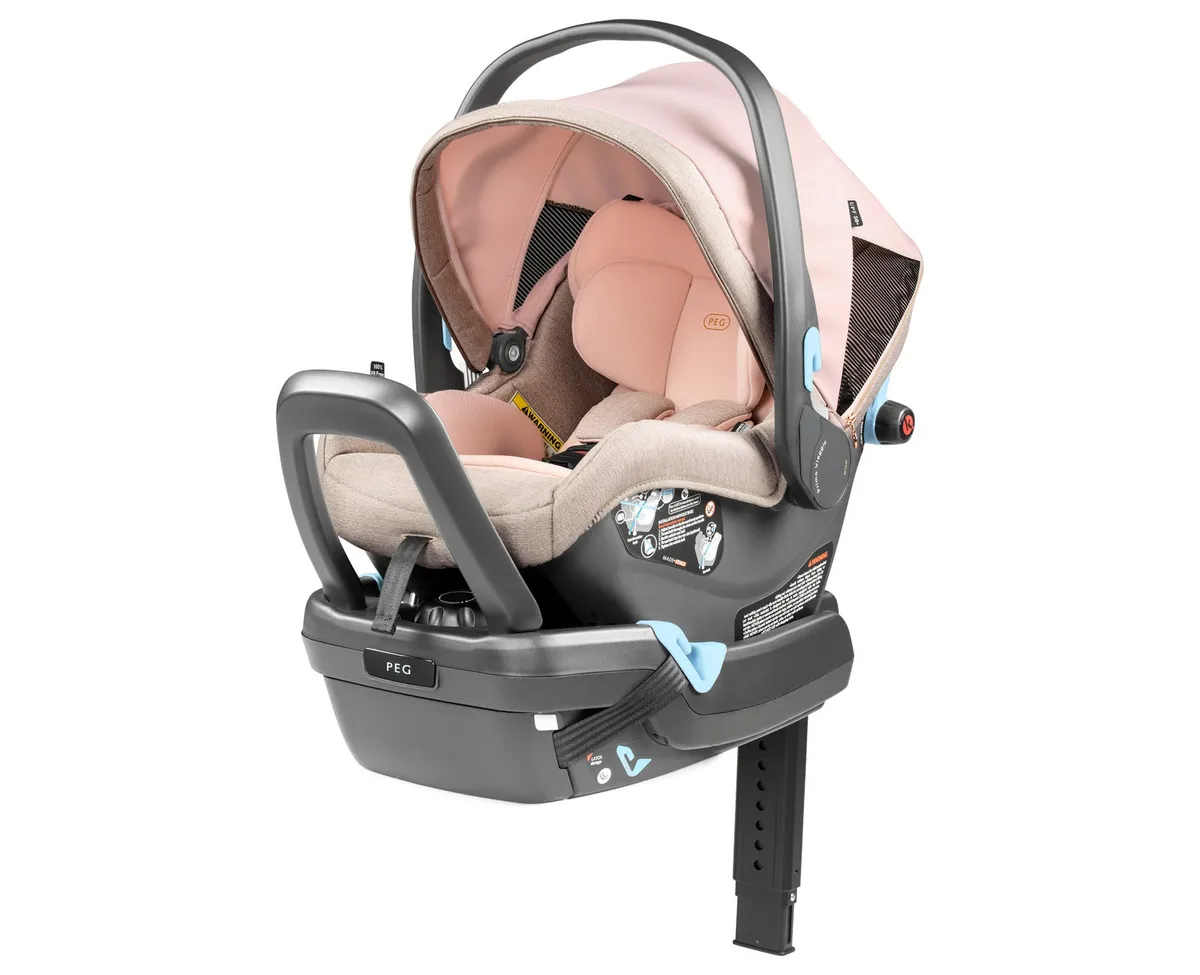
The Primo Viaggio Nido is one of the few US infant seats with both a load leg and an anti-rebound bar, on a made-in-Italy carrier certified to the federal side-impact standard, but it now tops out at 30 lb, not 35.
- Rear-facing
What we like
The load leg gives a more stable install and less rotation in a frontal crash, according to the manual, and the base's anti-rebound bar adds protection in a rear collision. Kinetic Pods on the door side add side-impact protection.
The harness has 6 positions and never needs rethreading, the European belt path makes taxis and travel easier, and the seat has a 7-year life from purchase and a 24-month warranty. It clicks into Peg Perego strollers, with adapters for some other brands.
Worth knowing
The 30 pound limit is 5 pounds less than the older 4-35 Nido. It sits in the premium price band and is wider than many carriers, at about 17.25 inches on its base.
Peg Perego doesn't allow lower-anchor borrowing, some vehicles don't allow a load leg in every position, and testers found the LATCH install and buckle fiddly on the older Nido.
Peg Perego’s Primo Viaggio has long been the infant seat for parents who want European-style safety hardware and Italian tailoring. The Primo Viaggio Nido is Peg Perego’s current version of the Nido: the Primo Viaggio carrier on a base with both a load leg and an anti-rebound bar, a pairing you rarely see on a US infant seat.
It fits babies rear-facing from 4 to 30 pounds and up to 32 inches. Every limit on this page comes from Peg Perego’s current US owner’s manual and product page. We compared the manuals and what testers and car seat technicians have published; we didn’t crash-test or install the seat ourselves.
Our verdict: the Nido is a beautifully built, safety-first carrier, and one of very few with a load leg and an anti-rebound bar together. Just know that it now holds 30 lb, not 35.
Coming from the Primo Viaggio 4-35 or 4-35 Nido? Read this first
This page replaces our old reviews of the Primo Viaggio 4-35 Nido and the base Primo Viaggio 4/35. Here’s what you need to know:
- The weight limit dropped from 35 lb to 30 lb. The current Nido and the current Primo Viaggio are both rated 4–30 lb. The height limit is still 32 inches.
- The “4-35” is gone from the name because it no longer describes the seat.
- The plain Primo Viaggio is the same carrier without the load leg. See “Nido or plain Primo Viaggio?” below.
Some stores still sell older 4-35 Nido K stock rated to 35 lb. If you already own a seat, go by the label on your seat and its own manual, not by this page.
Key features of the Primo Viaggio Nido
- Load-leg base (10-position metal leg, per Peg Perego) plus an anti-rebound bar
- Kinetic Pods and a 6-position no-rethread harness
- Installs without the base; FAA certified (carrier only)
- Certified to FMVSS 213, 213a and 213b, per Peg Perego
- Extendable UPF 50+ pagoda hood, no added flame retardants, made in Italy
What changed from the Primo Viaggio 4-35 Nido
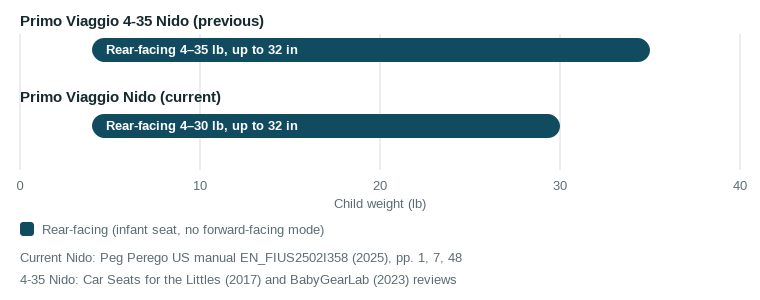
Lower weight limit: 35 → 30 lb (height still 32 in)
Let’s be plain: the current Nido holds 5 pounds less than the 4-35 Nido did. The older seat was rated 4–35 lb, according to Car Seats for the Littles and BabyGearLab. The current manual says 4–30 lb. The height limit is unchanged at 32 inches.
Most babies outgrow an infant seat by height or head room before weight, and 30 lb / 32 in is now the common ceiling for premium infant seats. But a heavy, shorter baby will move to a convertible seat sooner than before.
Certified to the federal side-impact standard
Peg Perego’s 2025 manual declares the Nido certified to FMVSS 213, 213a (the federal side-impact standard) and 213b. 213a is required for child seats made on or after December 5, 2026. That’s Peg Perego’s declaration, not a test result. We couldn’t find the older 4-35 Nido’s manual, so we can’t say how it was certified.
Stricter install rules and a purchase-based expiry
- No more lower-anchor borrowing. The current manual says Peg Perego doesn’t allow “borrowing” lower anchors from the outer seats; use the vehicle belt in the center instead. The older 4-35 Nido’s manual allowed it, per Car Seats for the Littles.
- The 7-year life now counts from the date of purchase (or from the production date on the label if you have no proof of purchase). The older seat counted 7 years from manufacture, per the same review.
What stayed the same
The load-leg base with its anti-rebound bar and Right Tight lockoff, push-on LATCH connectors on a strap, the no-rethread harness, the dual-stage cushion, the European belt path, the pagoda hood and FAA approval.
Nido or plain Primo Viaggio? Which version to buy
The only real difference is the load leg. Both use the same carrier, with the same limits and the same certifications.
| Primo Viaggio Nido | Primo Viaggio | |
|---|---|---|
| Limits | 4–30 lb, up to 32 in | 4–30 lb, up to 32 in |
| Base | Load leg and anti-rebound bar | Anti-rebound bar, no load leg |
| Carrier | 8.2 lb, Kinetic Pods | Same |
| Standards | FMVSS 213, 213a, 213b | Same |
| Useful life | 7 years from purchase | Same |
| Price band | High | High, but lower than the Nido |
Choose the Nido if you want the load leg and your back seat can take one. Choose the plain Primo Viaggio if your car has an under-floor storage bin where the leg would sit, or if you’d rather spend less for the same carrier. Peg Perego’s product page lists the pagoda hood for the Nido; check the listing if you want it on the plain model.
Can I use my old 4-35 base?
Peg Perego doesn’t confirm that older 4-35-era bases work with the current Nido. Use the base that comes in the box or a current Primo Viaggio extra base. If you want to reuse an older base, call Peg Perego at 1-800-671-1701 first. Whichever base you use, the carrier’s 30 lb limit applies, and an old base can still be past its own expiry.
What are the size limits of the Nido?
The Nido is rear-facing only. Per the owner’s manual, your baby can ride in it while:
| Rear-facing | Primo Viaggio Nido |
|---|---|
| Weight | 4–30 lb |
| Height | 32 in or less |
| Head | At least 1 in between the top of the head and the top of the seat back |
| Harness | At or just below the shoulders |
| Dual-stage cushion | Birth to about 20 lb |
Move on as soon as your baby passes any of these limits. If your baby was born at a low birth weight, the manual says to ask your doctor first.
How big is it, and will it fit your car?
Peg Perego lists the carrier at 8.2 lb without the hood and inserts, and the base at 11 lb. As you’d actually carry it, expect more: BabyGearLab weighed the older 4-35 Nido at 10.6 lb. It’s about 17.25 inches wide on its base, which is wider than many infant seats, so check our three-across guide if your back row is tight.
Check your floor before you buy. The load leg’s foot must touch the vehicle floor, and if your car has a floor panel that folds or opens, your vehicle manual has to allow a load leg there.
How safe is the Nido?
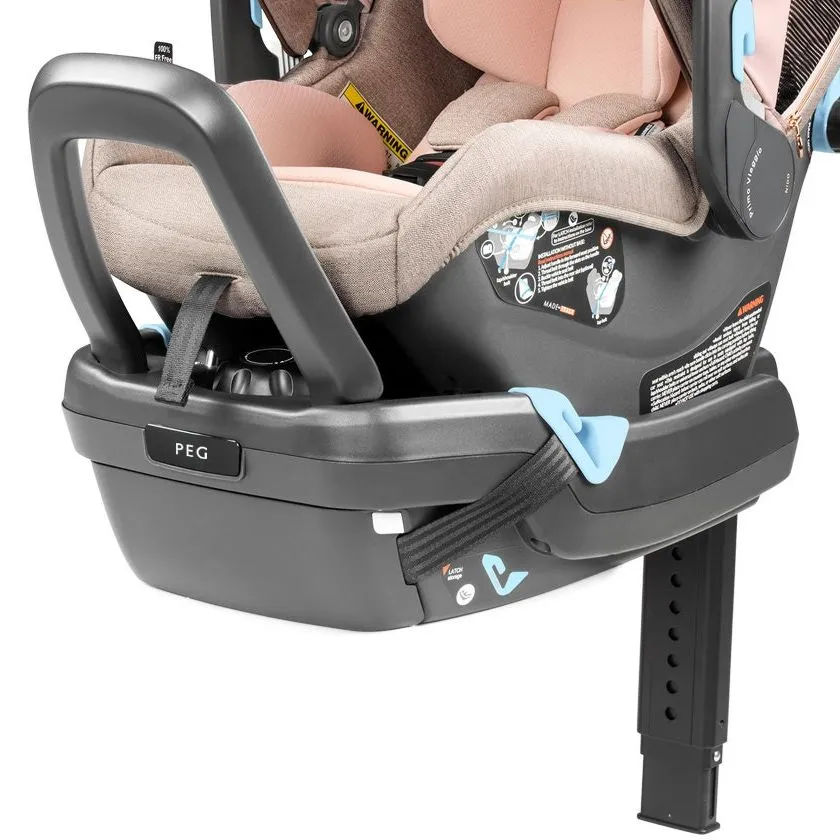
Image: Peg Perego
The load leg. The manual says the seat is certified with or without the leg, but the leg gives a more stable installation and less rotation of the seat in a frontal crash.
The anti-rebound bar. It snaps into the base at first use and, per the manual, adds protection in a rear collision and as the seat moves in a crash. Without the base, the carry handle goes in its forward-most position and does the anti-rebound job.
Side impact. On the side facing the car door, you pull out the Kinetic Pod completely; never pull out the one on the inboard side. The shell is lined with EPS foam, the headrest with EPP foam, and the side-impact head protection adjusts to 6 positions.
Recalls. We found no car-seat recalls for Peg Perego (Safe Ride News list revised Aug 31, 2026; Peg Perego’s recall page lists only a high chair and stroller bassinets). Register your seat so Peg Perego can reach you.
After a crash. NHTSA says a seat can be reused after a minor crash only if all of these are true: the car could be driven away, the door nearest the seat wasn’t damaged, nobody was hurt, the airbags didn’t deploy and the seat shows no visible damage. Otherwise, replace it. If you’re unsure, call Peg Perego at 1-800-671-1701.
How hard is it to install?
With the base
The base installs with push-on LATCH connectors on a strap (push each onto the anchor until it clicks, then tighten), or with the vehicle belt. Either way, close the Right Tight lockoff, level the base with its bubble indicator, extend the load leg to the floor and aim for less than 1 inch of movement. Inflatable seat belts are allowed with the base (lap portion only). A locking clip isn’t included. Testers found the LATCH install on the older 4-35 Nido fiddlier than average, so practice first.
Without the base (European belt path)
For taxis and travel, the lap belt goes through the slots on the handle, and the shoulder belt wraps around the back of the carrier into the rear slots. Lock the belt, put the handle forward-most and get the carrier’s line level (a rolled towel or pool noodle may help). Never install it without the base using an inflatable seat belt. The manual says to use the base when you can.
On an airplane
The Nido is certified for aircraft use: carrier only. Route the plane’s lap belt through the handle slots, put the handle forward-most and don’t use the base on the plane. More tips are in our airplane car seat guide.
Comfort, everyday use and strollers
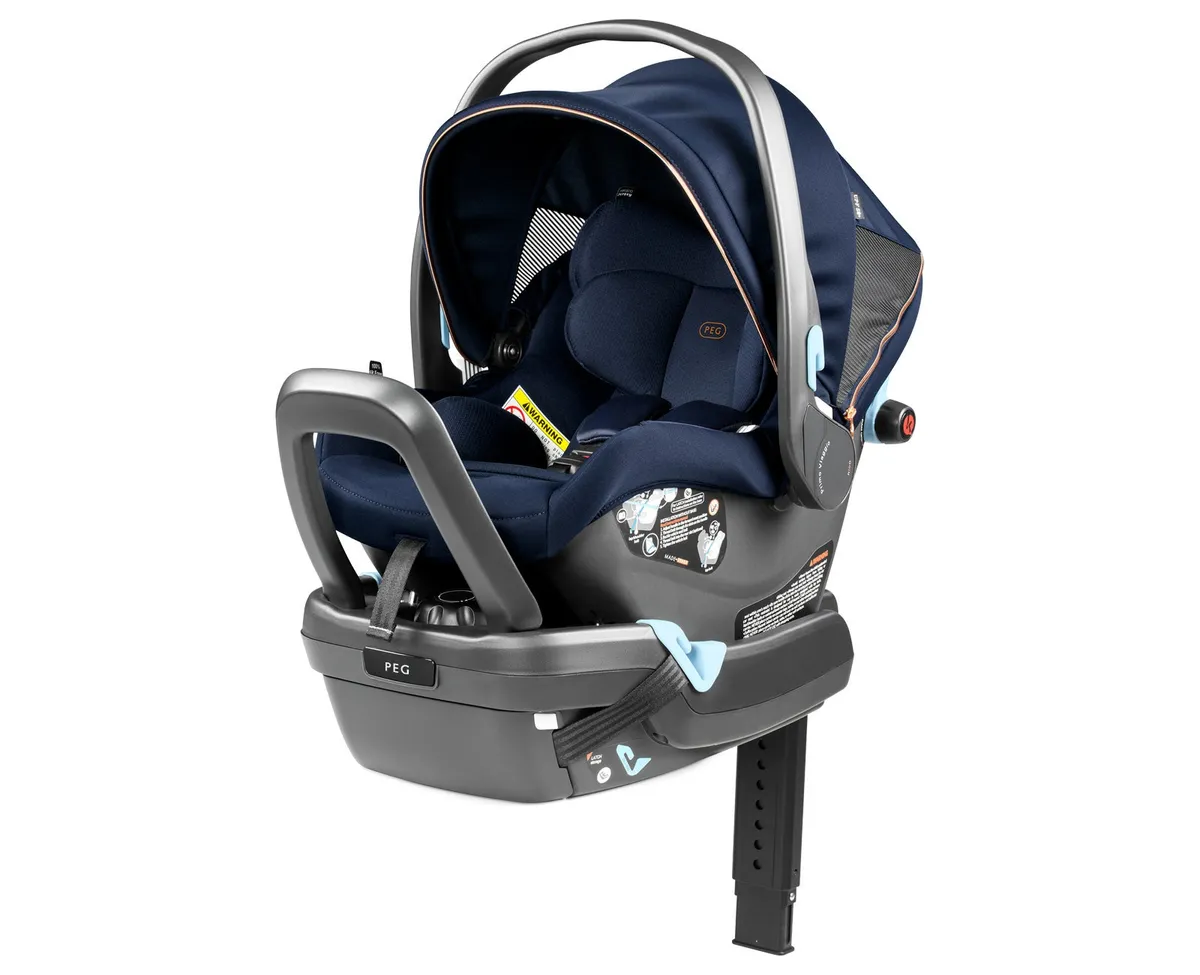
Image: Peg Perego
The harness and headrest move together through 6 positions. The extendable pagoda hood can cover the baby fully, with UPF 50+ fabric and mesh side panels. The cover is hand-wash only, and testers called the older seat’s buckle stiff.
Peg Perego says the Nido clicks into its YPSI, Z4, Vivace, Veloce, Selfie, Selfie Plus, City Loop and Booklet 50 strollers. For other brands, it sells universal and UPPAbaby adapters; check your stroller model.
How it compares
The CYBEX Aton G2 has the same 4–30 lb / 32 in limits and a load leg, but no anti-rebound bar on the base. The UPPAbaby Mesa also tops out at 30 lb and suits UPPAbaby stroller families. The Chicco KeyFit costs less and has an anti-rebound bar but no load leg. The Nuna PIPA series is the other premium seat parents cross-shop; check its current limits on Nuna’s site.
BestCarSeatHub’s final verdict

- Load leg and anti-rebound bar on the same base
- Certified to FMVSS 213, 213a and 213b, per Peg Perego
- Kinetic Pods and adjustable side-impact head protection
- Travel-friendly: European belt path and FAA certified (carrier only)
- 7-year life from purchase, plus a 24-month warranty
- Big UPF 50+ pagoda hood and Italian build quality

- 30 lb limit, 5 lb less than the 4-35 Nido
- Premium price band
- Wider than many carriers (about 17.25 in on its base)
- No lower-anchor borrowing, so center-seat installs use the belt
- LATCH install and buckle can be fiddly, according to testers
- Older 4-35 bases aren’t confirmed to fit
Who it’s for
Parents who want both a load leg and an anti-rebound bar on a made-in-Italy carrier, especially Peg Perego stroller families.
Who should skip it
- Families with a heavy but shorter baby who want a 35 lb seat.
- Cars where a load leg isn’t allowed. The plain Primo Viaggio is the same carrier without it.
- Anyone on a budget. The KeyFit covers the same size range in a lower price band.
- Tight back rows, where a narrower carrier will fit more easily.
When your baby outgrows the Nido, Peg Perego’s Primo Viaggio Convertible keeps them rear-facing longer. To see how the Nido ranks, head back to our safest infant car seats list.
- Seat type
- Rear-facing-only infant seat (carrier with load-leg base)
- Rear-facing
- 4–30 lb and 32 in or less; at least 1 in between the top of the head and the top of the seat back
- Dual-stage cushion
- Birth to about 20 lb, or until the torso fills the space between the crotch strap and shoulder slots
- Harness
- 6 positions, no rethreading
- Load leg
- Yes, on the Premium Base (10-position metal leg, per Peg Perego); certified with or without it
- Anti-rebound
- Anti-rebound bar on the base; carry handle forward-most when installed without the base
- Side impact
- Kinetic Pods (door side) and 6-position side-impact head protection
- Federal standards
- FMVSS 213, 213a and 213b (Peg Perego declaration of conformity)
- Carrier weight
- 8.2 lb without hood and inserts (Peg Perego)
- Base weight
- 11 lb (Peg Perego)
- Width
- About 17.25 in on its base (Peg Perego)
- Installation
- Base: push-on LATCH connectors on a strap, or vehicle belt with the Right Tight lockoff; without the base: European or lap-only belt routing
- Lower-anchor borrowing
- Not allowed
- FAA
- Certified for aircraft, carrier only (no base)
- Fabrics
- No added flame retardants; UPF 50+ pagoda hood (Peg Perego)
- Made in
- Italy
- Useful life
- 7 years from the date of purchase (production date on the label if you have no proof of purchase)
- Warranty
- 24 months from purchase