convertible seat
Chicco OneFit Max ClearTex Car Seat Review
by chicco
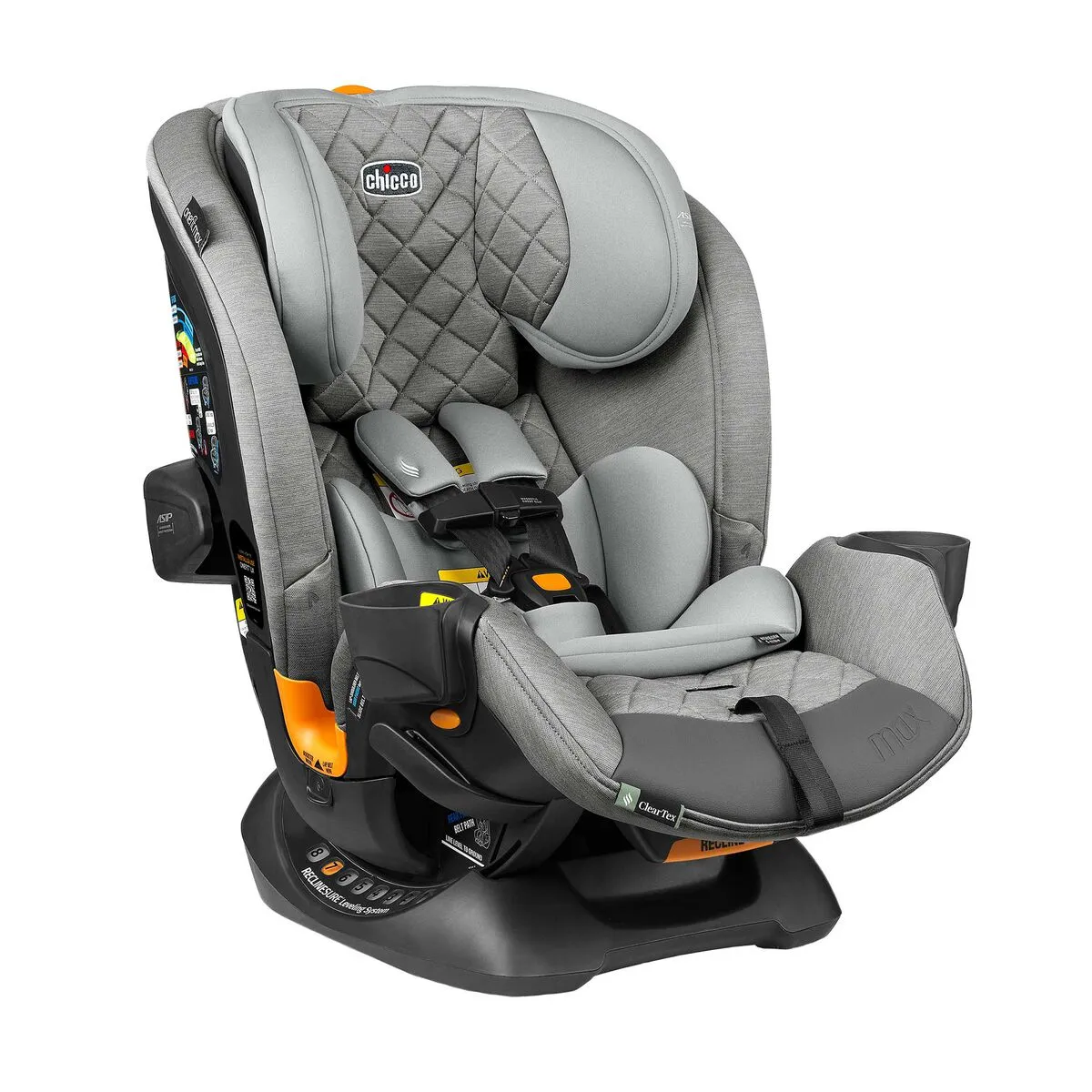
The Chicco OneFit Max pairs Chicco's LeverLock forward-facing belt install and SuperCinch lower anchors with a harness rated to 54 inches and FAA use in both harness directions, but it rear-faces only to 40 lb and 43 in, has no backless mode, and is a big seat at about 27 lb and 19.5 in wide.
- Rear-facing
- Forward-facing
- Booster
What we like
LeverLock secures forward-facing seat-belt installs, a rear-facing lock-off handles rear-facing belt installs, and SuperCinch tightens the lower anchors. The harness is rated to 54 in, with no minimum height to turn forward-facing.
It's FAA certified in both harness directions, has a 10-year useful life, and Chicco says it meets FMVSS 213b and the FMVSS 213a side-impact standard in harnessed modes.
Worth knowing
It rear-faces only to 40 lb and 43 in, and it's big: about 27 lb and 19.5 in wide, per Babylist and Safe in the Seat. The lower anchors stop at a 35 lb child rear-facing and 40 lb forward-facing.
There's no backless booster, no rear-facing tether, and no anti-rebound bar or load leg, and it isn't certified for aircraft in booster mode. Safe in the Seat finds it hard to buckle in booster mode.
Some families want one car seat that does everything: rear-facing for the baby years, a harness for the preschool years, then a booster until the seat belt fits on its own. The Chicco OneFit Max ClearTex is Chicco’s take on that idea, and its pitch is installation. It uses Chicco’s LeverLock tensioner for forward-facing seat-belt installs and the SuperCinch tightener on the lower anchors.
Every child limit on this page comes from Chicco’s US owner’s manual for the OneFit Max (IS0243E_04, dated 10/24). We read the limits pages and compared them with Chicco’s product page. We haven’t tested the seat ourselves; this review is research-based.
Our verdict: the OneFit Max is a solid all-in-one for parents who want a firm, simple seat-belt install and a tall forward-facing harness. It gives up some rear-facing room (40 lb and 43 in), there’s no backless booster, and at about 27 lb and 19.5 in wide it’s not a seat for small cars or three-across.
Key features of the Chicco OneFit Max
- Three modes: rear-facing harness, forward-facing harness and high-back booster (no backless mode)
- LeverLock for forward-facing seat-belt installs, and a rear-facing lock-off
- SuperCinch lower-anchor tightener
- Forward-facing harness rated to 54 in, with no minimum height to turn forward
- FAA certified rear-facing and forward-facing in harness mode
- 10-year useful life
- A Newborn Positioner for babies from 5 to 11 lb
- ClearTex fabric made without flame-retardant chemical treatments, and GREENGUARD Gold certification, per Chicco
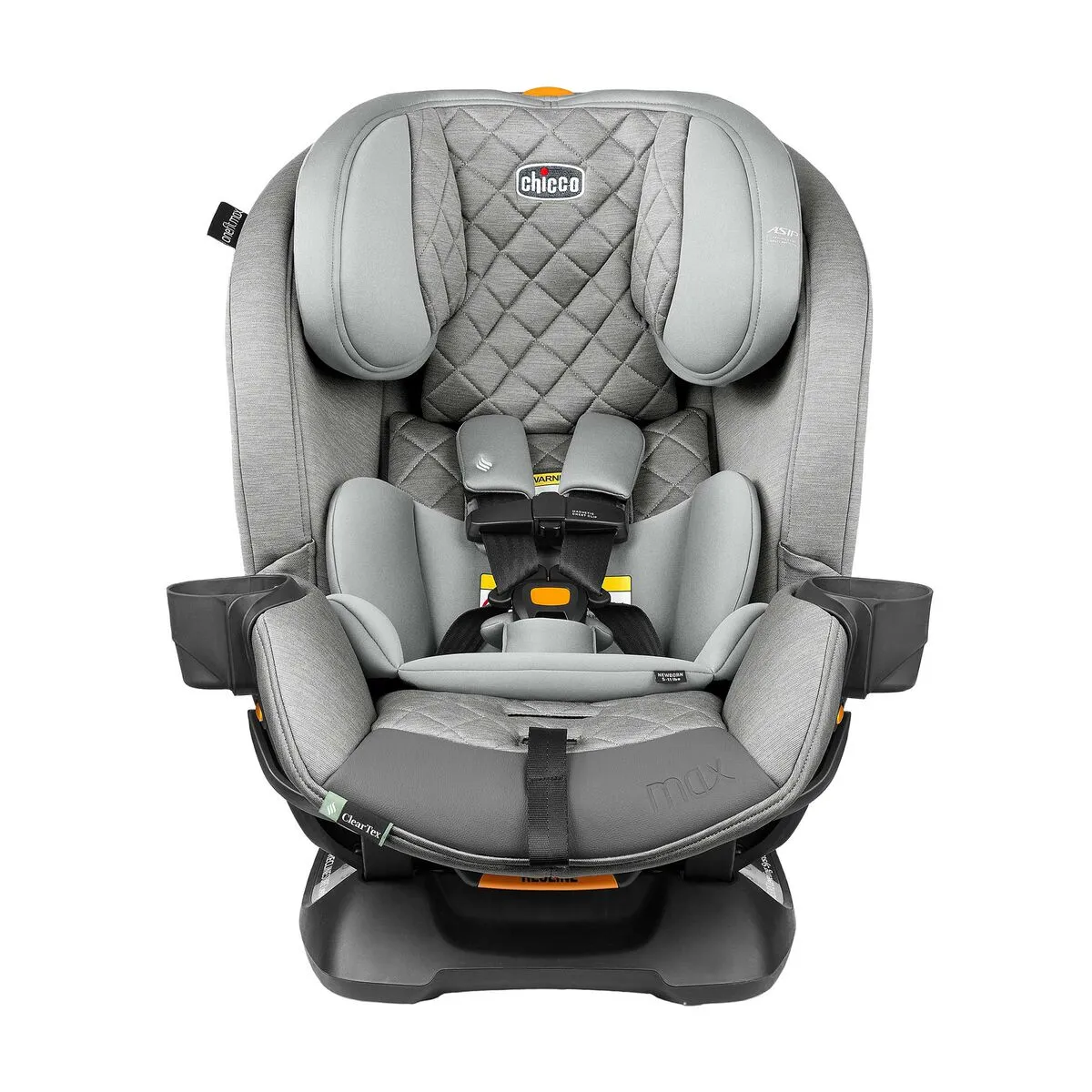
Image: Chicco
What changed: the OneFit Max and Chicco’s other OneFit seats
There’s no earlier OneFit review on our site, and Chicco doesn’t present the Max as a replacement for another seat. Here’s how the family looks today:
- OneFit Max ClearTex: the seat in this review. Its manual (IS0243E_04) is dated 10/24.
- OneFit LX ClearTex: Chicco also sells this seat. Its product page lists the same usage limits as the Max’s page, but it has its own manual (IS0235E_07), so follow that manual and your seat’s label. We haven’t compared the two seats’ features, so don’t treat them as identical.
- OneFit ClearTex: the earlier OneFit, which we no longer found on Chicco’s site. NHTSA’s car seat database lists it with no recalls.
What are the child size limits of the Chicco OneFit Max?
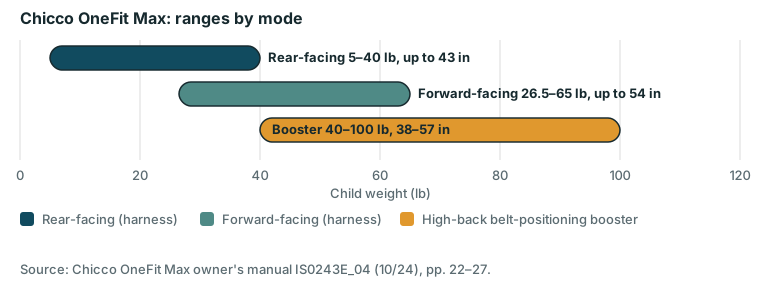
Ranges by mode, from Chicco’s US owner’s manual. Chart: BestCarSeatHub.
| Mode | Weight | Height and other rules |
|---|---|---|
| Rear-facing harness | 5–40 lb | No taller than 43 in; harness at or below the shoulders |
| Forward-facing harness | 26.5–65 lb | At least 1 year old; no taller than 54 in or ears below the top of the head rest; harness at or above the shoulders |
| High-back booster | 40–100 lb | 38–57 in; at least 4 years old; able to sit still and properly in a seat belt |
Overall, Chicco says the seat is only for children from 5 to 100 lb and 57 in or less.
Rear-facing (5–40 lb, up to 43 in)
Your child rides rear-facing from 5 to 40 lb and up to 43 in, with the harness straps at or below the shoulders. Never turn the seat forward-facing with a baby under 1 year old, and ideally rear-face to 40 lb or 43 in. That height cap is lower than on some all-in-ones, which rear-face to 49 in. Here’s why rear-facing limits matter.
Forward-facing harness (26.5–65 lb, up to 54 in)
To ride forward-facing, your child must be at least 1 year old and at least 26.5 lb. There’s no minimum height, unlike Chicco’s Fit3x.
Chicco’s manual says to use the forward-facing harness for children who are no taller than 54 inches or whose ears are still below the top of the head rest, with the harness straps at or above the shoulders.
High-back booster (40–100 lb, 38–57 in)
In booster mode, your child must be at least 4 years old, 40 to 100 lb and 38 to 57 in tall, and able to sit still and properly in a seat belt at all times. The vehicle’s lap and shoulder belt holds your child; never use a lap-only belt. There’s no backless mode.
Some retailer and review listings give 44 inches as the booster minimum; the OneFit Max manual says 38 inches, along with at least 40 lb and 4 years old. Follow the manual in the box and the label on your seat. See when to switch to a booster.
Newborns: the Newborn Positioner (5–11 lb)
The Newborn Positioner is for rear-facing only, for babies from 5 to 11 lb. For a premature baby, Chicco says to ask the baby’s doctor before using the seat.
How big is the OneFit Max, and will it fit your car?
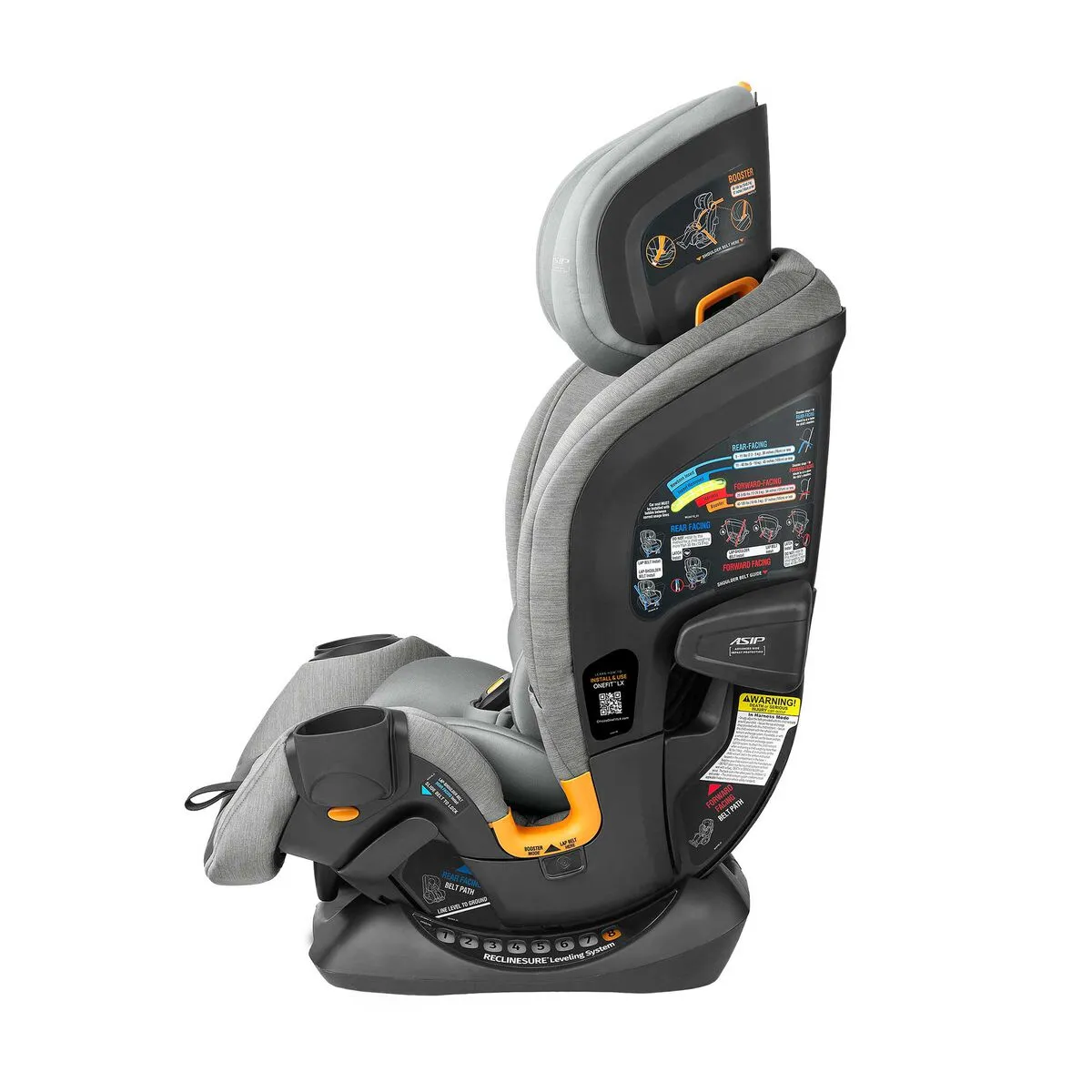
Image: Chicco
Babylist and Safe in the Seat both list the OneFit Max at about 27 lb and 19.5 in wide; Chicco’s own figures weren’t available to us. Babylist gives 23.5 x 19.5 x 27 in overall. That’s heavy for an all-in-one, so it suits a car where it can stay put.
Safe in the Seat, a site run by a certified car seat technician, suggests caution if you need three across or have non-removable vehicle headrests. Measure your back seat first, and see our three-across guide. The manual also says no more than 3 in of the seat’s base may hang past the edge of the vehicle seat.
How safe is the Chicco OneFit Max?
Chicco says the OneFit Max meets FMVSS 213b (frontal) and the FMVSS 213a side-impact standard in its harnessed modes. The 213a standard applies to seats made on or after Dec 5, 2026. These are Chicco’s statements on its product page; the owner’s manual doesn’t make the claim, and the claim covers the harness modes, not booster mode.
What the manual spells out:
- Replace the seat after any crash, even if you can’t see damage.
- Useful life: 10 years. Check the “Do Not Use After” date on the label under the seat.
- Never use the top tether rear-facing. Always use it forward-facing when there’s a tether anchor.
- Never rear-face in front of an active frontal airbag; the back seat is safest.
There’s no anti-rebound bar and no load leg, which some rivals add for rear-facing.
Recalls: We found no recall or investigation for any Chicco OneFit model when we checked (November 2026). NHTSA’s database doesn’t list the OneFit Max by name yet, so register your seat with Chicco to hear about any future notice.
How easy is the OneFit Max to install and use?
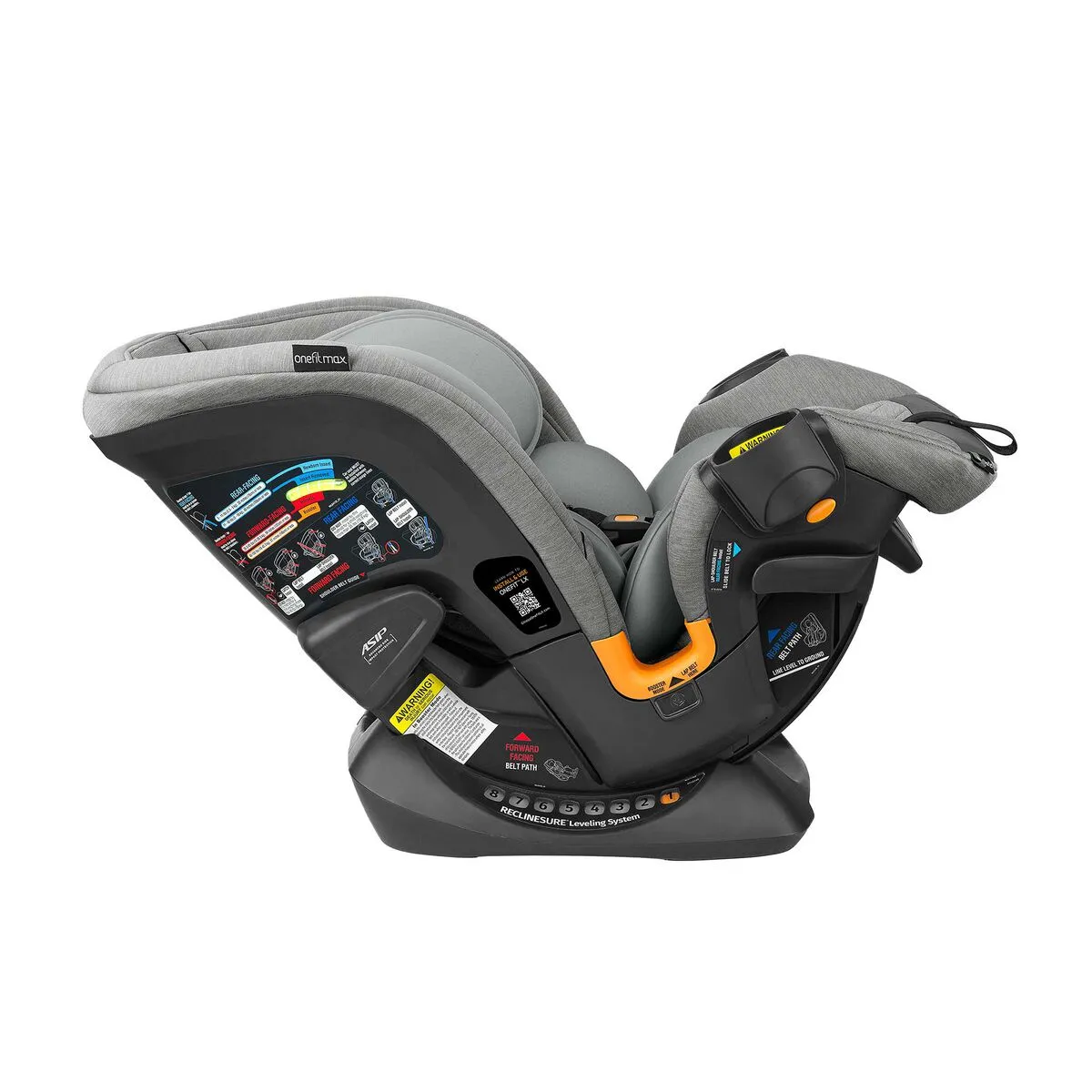
The OneFit Max reclined. Image: Chicco
The seat has a bubble level on each side, and Chicco says proper recline is required. Whatever the method, the installed seat shouldn’t move more than 1 inch side to side or forward at the belt path. Don’t put a pool noodle or towel under it.
Rear-facing: lower anchors or the belt lock-off
Use the lower anchors with the SuperCinch tightener until your child weighs 35 lb, then switch to a seat-belt install. With the belt, clamp it in the rear-facing lock-off. The manual says locking the belt’s retractor is optional here, because the lock-off does that job, and locking it rear-facing may tilt the seat.
Forward-facing: LeverLock, or lower anchors to 40 lb
Forward-facing, you can use the lower anchors until your child weighs 40 lb. For a seat-belt install, the belt must always be routed and secured with LeverLock, and Chicco recommends the lap-and-shoulder belt with the top tether. Don’t install with motorized, door-mounted, inflatable or non-locking lap belts.
The tether: forward-facing only
Always use the top tether forward-facing when your car has an anchor. Never use it rear-facing.
Booster install
In booster mode, the lower anchors and top tether are completely optional, per the manual. If you don’t use them, buckle the empty seat with the vehicle belt so it can’t fly around. Safe in the Seat notes it can be hard to buckle in booster mode.
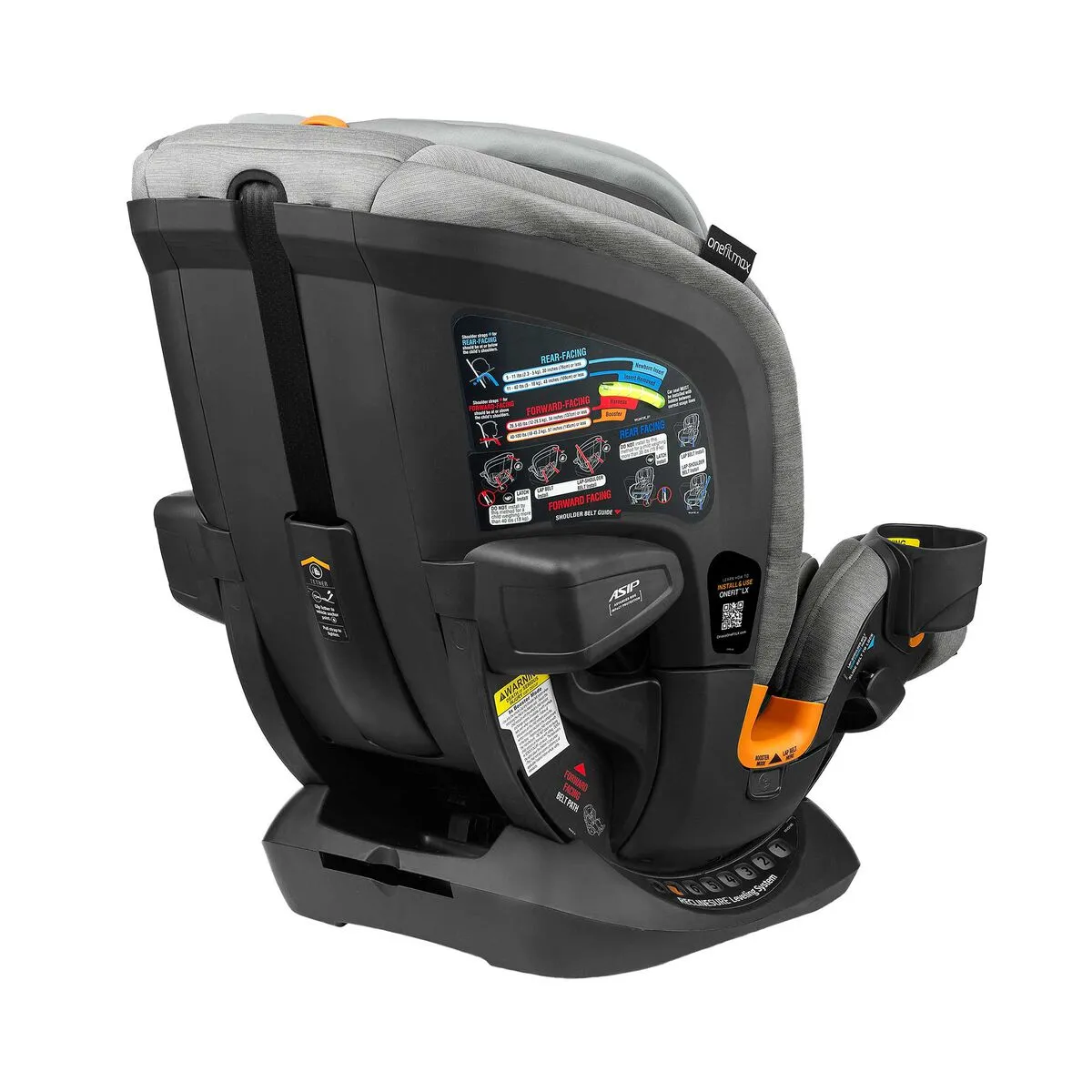
Image: Chicco
On an airplane
The OneFit Max is certified for aircraft use in harness mode only, rear-facing or forward-facing, on forward-facing aircraft seats. It’s not certified in booster mode. Never use LeverLock on a plane; keep its handle latched closed. See our guide to flying with a car seat.
Chicco OneFit Max vs the alternatives
Graco 4Ever DLX 4-in-1: our top-rated all-in-one. It rear-faces to 49 in and adds a backless booster to 120 lb. The OneFit Max’s edges are LeverLock and a taller harness rating (54 in vs 49 in).
Chicco Fit3x: same brand, same rear-facing and harness weight limits, but 16.7 in wide and 21 lb per Chicco. Choose it for small cars. Its catch is a 38 in minimum height to forward-face, which the OneFit Max doesn’t have.
Safety 1st Grow and Go All-in-One: a lower-priced, lighter pick, but its harness tops out at 49 in and it forward-faces from 30 lb.
Joie Saffron SI: rated the same as the OneFit Max, with a backless booster to 120 lb, but it isn’t certified for aircraft.
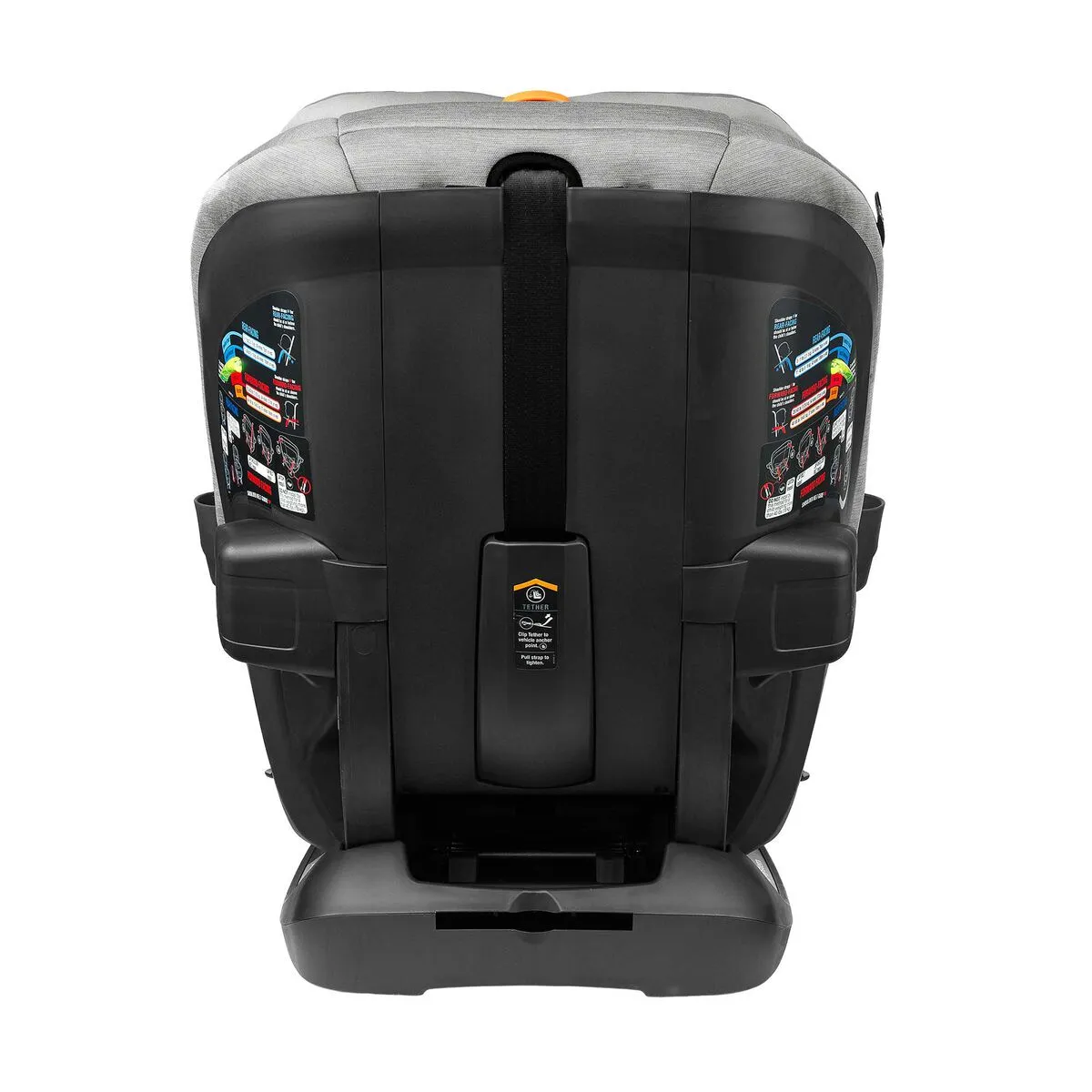
The back of the shell. Image: Chicco
BestCarSeatHub’s Final Verdict

- LeverLock for forward-facing belt installs; rear-facing lock-off
- SuperCinch lower-anchor tightener
- Harness rated to 54 in, with no minimum height to forward-face
- FAA certified in both harness directions
- 10-year useful life
- Chicco’s 213a (harnessed modes) and 213b claims

- Rear-facing only to 40 lb and 43 in
- About 27 lb and 19.5 in wide (Babylist, Safe in the Seat)
- No backless booster; booster ends at 100 lb
- No rear-facing tether, anti-rebound bar or load leg
- Not certified for aircraft in booster mode
- Safe in the Seat finds it hard to buckle in booster mode
Who it’s for
Parents who want one seat from baby to booster, a straightforward seat-belt install, and room for a tall preschooler in the harness. It also suits families who fly and want to use the harness on the plane.
Who should skip it
- Small cars, three-across, or frequent seat swaps: look at the Chicco Fit3x.
- Anyone who wants a backless booster later from the same seat.
- Parents who want extended rear-facing by height, or an anti-rebound bar or load leg.
Frequently asked questions
When can my child face forward in the OneFit Max? At least 1 year old and 26.5 lb, but rear-face until your child reaches 40 lb or 43 in.
What’s the lower-anchor limit? A 35 lb child rear-facing and a 40 lb child forward-facing. After that, use the seat belt.
Can I use the tether rear-facing? No. The tether is forward-facing only.
OneFit Max or OneFit LX? Chicco’s pages list the same usage limits, but each seat has its own manual. Follow the one for your seat.
The Chicco OneFit Max is an easy all-in-one to shortlist if seat-belt installs worry you. Check the label on your seat, keep the manual in the car, and have your install checked by a certified car seat technician. Compare it with the rest of our top-rated car seats.
- Modes
- Rear-facing harness, forward-facing harness, high-back belt-positioning booster (no backless mode)
- Rear-facing
- 5–40 lb and no taller than 43 in; harness at or below the shoulders
- Forward-facing harness
- 26.5–65 lb; at least 1 year old; no taller than 54 in or ears below the top of the head rest; harness at or above the shoulders
- High-back booster
- 40–100 lb and 38–57 in; at least 4 years old; able to sit still and properly in a seat belt; vehicle lap and shoulder belt only
- Newborn Positioner
- Rear-facing only, 5–11 lb
- Lower anchor (LATCH) limit
- Child weight 35 lb rear-facing, 40 lb forward-facing (with the harness); optional in booster mode
- Belt installs
- Rear-facing lock-off; forward-facing belt installs must use LeverLock
- Top tether
- Always forward-facing when an anchor is available; never rear-facing
- Anti-rebound bar / load leg
- None
- Width
- About 19.5 in (Babylist, Safe in the Seat)
- Seat weight
- About 27 lb (Babylist, Safe in the Seat)
- FAA
- Certified in rear-facing and forward-facing harness modes, on forward-facing aircraft seats only; never with LeverLock; not certified in booster mode
- Federal standard
- Chicco says it meets FMVSS 213b and the FMVSS 213a side-impact standard in harnessed modes
- Useful life
- 10 years; check the "Do Not Use After" label under the seat
- After a crash
- Replace after any crash, even with no visible damage
- Owner's manual
- IS0243E_04 (10/24)