convertible seat
Safety 1st Turn and Go 360 DLX Review
by safety1st
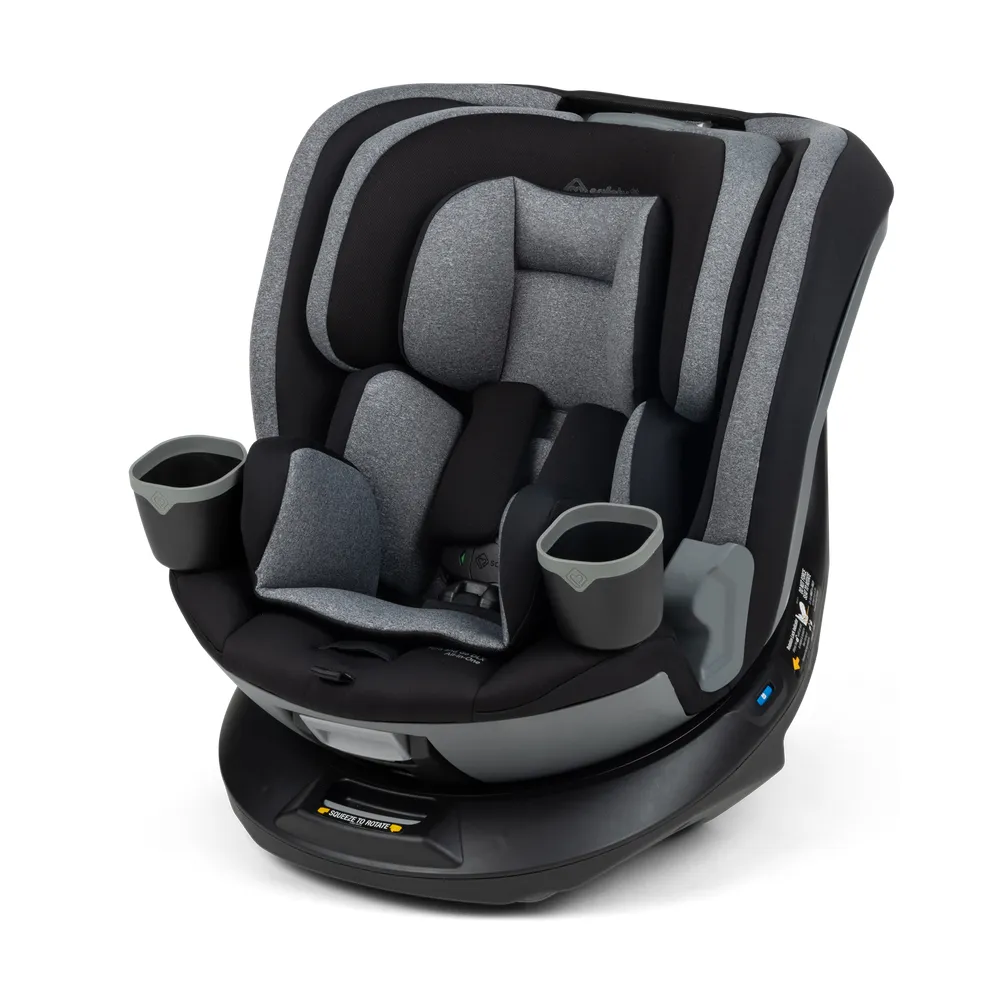
The Turn and Go 360 DLX is a mid-priced rotating all-in-one that turns toward the door in every mode, from a 5 lb newborn to a 100 lb booster rider, but it rear-faces only to 40 lb and 40 in, isn't certified for aircraft in any mode and is heavy, so it suits car-only families who want rotation for the long haul.
- Rear-facing
- Forward-facing
- Booster
What we like
It rotates in every mode, so you can buckle your child in facing the door from the newborn stage through the booster years, and one seat covers 5 to 100 pounds. Safety 1st's red-to-green tension indicators and built-in belt lock-off help you check the install.
It has a 10-year useful life, sits in a mid price band for a rotating seat, and we found no recall or investigation when we checked (November 2026).
Worth knowing
It's not certified for aircraft in any mode and rear-faces only to 40 lb and 40 inches. LATCH is rated to just 30 lb rear-facing and 35 lb forward-facing, and the manual requires the tether in all modes when an anchor is available.
It's heavy (Babylist lists the DLX at 33.2 lb), the booster stops at 52 inches with no backless mode, and the warranty is one year. Car Seats for the Littles found an earlier version awkward to install in 2023.
❮ More Convertible and All-in-One Car Seats
Rotating seats save your back. Instead of leaning into the car to buckle a wriggling toddler, you turn the seat to face the open door, buckle your child in, then turn it back and lock it. Most rotating seats only do this for the harness years. The Safety 1st Turn and Go 360 DLX keeps rotating through all three of its modes, right up to a 100 lb booster rider, at a mid-range price. Every limit on this page comes from Safety 1st’s owner’s manual (4358-8658, rev 02.24.25) and its product pages. We haven’t used or crash-tested the seat ourselves.
Our verdict: the Turn and Go 360 is a sensible rotating all-in-one for families who drive, not fly. You get rotation in every mode, red-to-green install indicators and a 10-year life. The trade-offs are real: rear-facing ends at 40 lb or 40 inches, it isn’t certified for aircraft in any mode, it’s heavy, LATCH tops out early and the booster stops at 52 inches. We rate it 8.2.
Why choose a rotating all-in-one?
An all-in-one takes your child from the ride home from the hospital to the booster years in one seat. Rotation makes the daily routine easier, especially rear-facing, when you’d otherwise be reaching over the side of a deep shell. The catch with rotating seats is size and weight: they’re big, and they’re meant to stay put. Treat this as an install-it-and-leave-it seat.
Key features of the Turn and Go 360 DLX
- Rotates in all three modes with Safety 1st’s SafetySwivel 360 and a one-hand rotation handle
- Rear-facing to 40 lb and 40 inches, forward-facing harness to 65 lb and 49 inches, high-back booster to 100 lb and 52 inches
- SecureTech red-to-green tension indicators on the base, plus a built-in belt lock-off
- 10-position headrest and harness and 5 recline positions for rear-facing (per Safety 1st)
- Infant inserts, two removable dishwasher-safe cup holders and a machine-washable pad (per Safety 1st)
- DLX extras, according to Safety 1st: a SecureTech magnetic chest clip and “antibacterial-treated” fabrics
What changed: Turn and Go 360 vs 360 DLX vs 360 ST
Safety 1st sells three versions side by side, and none of them replaces another. Safety 1st’s manual, whose cover names the 360, 360 DLX and 360 ST, is linked from all three product pages, and all three pages list the same size limits. The differences Safety 1st lists:
| Feature (per Safety 1st’s pages) | 360 DLX | 360 | 360 ST |
|---|---|---|---|
| SecureTech magnetic chest clip | Listed | Not listed | Not listed |
| Fabrics | “Antibacterial-treated” | “Premium” | “Premium” |
| Top-tether visual indicator | Listed | Listed | Not listed |
| Size limits | Same | Same | Same |
A magnetic chest clip comes on select versions (Safety 1st lists it for the DLX). The manual covers both a standard chest clip and the magnetic one. If your seat has the magnetic clip, the manual warns against using it for a child with an implanted electronic medical device, and says caregivers with one should keep their device away from the clip.
The Turn and Go line has been around for a while, so you may see an older seat. Older Turn and Go labels may show different limits (for example a lower forward-facing minimum); the current manual says 30 lb. Follow the label on your seat.
What are the child size limits?
According to the owner’s manual, your child must stay in each mode until they outgrow any one of its limits.
| Mode | Weight | Height | Other rules |
|---|---|---|---|
| Rear-facing harness | 5–40 lb | 19–40 in | Top of head at least 1 in below the top of the headrest; harness at or slightly below the shoulders |
| Forward-facing harness | 30–65 lb | 34.4–49 in | Only after outgrowing rear-facing; tops of ears below the top of the headrest; harness at or slightly above the shoulders |
| High-back booster | 40–100 lb | 43.4–52 in | Vehicle lap and shoulder belt only; ears never above the headrest; head at least 5 in below the car’s roof |
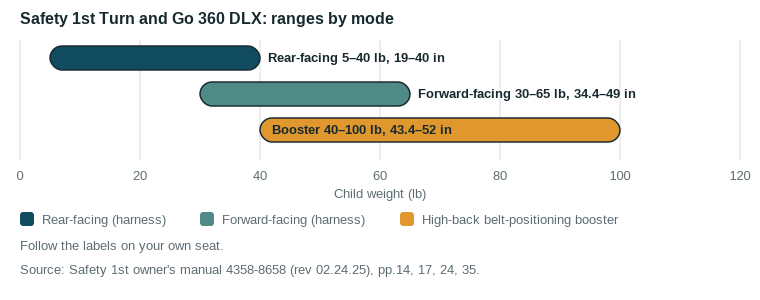
There’s no backless booster mode, and the manual gives no minimum age for any mode. Safety 1st markets it as “birth to 10 years”, but weight, height and fit decide each step.
For newborns, the manual uses two level lines. From 5 to 30 lb and 19 to 34.3 inches, the bottom line must be parallel with the ground. From 30 to 40 lb and 34.4 to 40 inches, and only once your child can sit up unassisted, use the top line (how recline indicators work). A tightly rolled towel or pool noodle under the front of the base is allowed “only if necessary”. More on why height limits matter: height and weight limits for rear-facing seats.
How big is it, and will it fit your car?
Safety 1st doesn’t publish the seat’s weight or width. Babylist lists the DLX at 33.2 lb and about 19.5 inches wide (22.75 in high, 23 in deep), and Car Seats for the Littles listed an earlier version at 30 lb in 2023. Either way, it’s a heavy seat, and not one for three-across or frequent car swaps. In the side seating positions, the manual says the seat must touch the back of the vehicle seat in front of it, or be as close as possible. Measure your back seat before you buy.
How safe is the Turn and Go 360?
Safety 1st’s product pages say it “Meets federal Side Impact standard”; the owner’s manual doesn’t mention side-impact testing. There’s no load leg or anti-rebound bar. We found no recall or investigation for the Turn and Go 360 when we checked (November 2026). Register your seat at djgusa.com/registration/carseat/us or 1-800-544-1108 so you’re told about any future recall.
The safety rule you’ll use every day: never ride side-facing. The manual allows the side-facing position only to put your child in or take them out, and the Rotation Lock Indicator should show the locked symbol before you drive.
After a crash, Safety 1st “strongly recommends replacing the car seat even after a minor crash, even if it was not occupied.” The manual also lists NHTSA’s five minor-crash criteria (and says you may not need to replace the seat only if all five are true). After a moderate or severe crash, you must replace it.
How hard is it to install and use?
One base install for the harness years
The seat is attached to its base by cable wires and shouldn’t be removed. You install the base side-facing, flip the seat over to reach the belt path, then flip it back. Once it’s in, the same install serves rear-facing and forward-facing, unless you used LATCH and your child passes the LATCH limit (below). Safety 1st says “installation of the base is the same for all 3 modes of use.” The manual’s booster pages don’t walk through the base install, though, and its booster warnings require the vehicle seat belt, so reread the manual (or ask a car seat technician) when you convert to booster.
With the seat belt and lock-off
Route the belt, push the base down and back, and close the built-in lock-off. If your car’s belt can switch to locking mode, the manual says you must use it. The SecureTech indicators turn fully green when the belt is tight, and the base shouldn’t move more than 1 inch at the belt path. Never use an emergency-locking lap-only belt or an inflatable belt.
LATCH (to 30 lb rear-facing, 35 lb forward-facing)
LATCH is rated to 30 lb child weight rear-facing and 35 lb forward-facing. Past that, reinstall with the seat belt. Never use LATCH and the seat belt together. In booster mode, the manual says not to use the lower anchor belt along with the vehicle belt, and the seat must stay belted in even when it’s empty. Car Seats for the Littles found the J-hook connectors on its earlier test seat hard to reach (2023).
The tether: every mode, rear-facing too
Safety 1st’s manual is unusually firm: “When top tether anchors are available, you MUST ALWAYS attach, adjust, and secure the tether (top anchorage) strap when installing the car seat in all modes.” That includes rear-facing, which surprises many US parents. If a seating position has no tether anchor, Safety 1st says to use a different position or have one installed by your dealer or a qualified mechanic. See our top tether guide.
Rotating: the rules
Squeeze the rotation handle on the front of the base to turn the seat. One quirk to know: “The car seat MUST be fully reclined in Position 5 BEFORE rotating it to forward-facing.” Check the lock indicator every time.
On an airplane
“This restraint is not certified for aircraft use”, in any mode. If you fly with your car seat, look at another seat (see our airplane car seat guide).
Expiration and warranty
Stop using the seat 10 years after its date of manufacture, printed on the label on the bottom of the seat. The warranty is one year from the original purchase, and you’ll need the original receipt.
What car seat experts said about an earlier version
Car Seats for the Littles reviewed an earlier, non-DLX Turn and Go in July 2023, under an older manual. It called the seat heavy and awkward to install, measured a top harness slot of 15 inches and a booster belt guide of about 16 inches, found the base tippy in booster mode, and summed up: “I’m coming up a bit short on this one.” It also noted the seat is inexpensive for a rotating seat. We found no expert review of the current version, so check how your child fits the top harness and booster positions before you buy.
How it compares
- Evenflo Revolve360 Slim (8.2): rear-faces to 50 lb and is certified for aircraft with the harness, but has no booster mode, a past recall on older units and an open NHTSA audit.
- Evenflo Revolve360 Extend (8.4): rear-faces to 50 lb with a booster to 120 lb; it’s covered by the same open audit.
- Graco Turn2Me (8.3): a 100 lb booster too, but it rotates only rear-facing.
- Chicco Fit360 (8.4): aircraft-certified, but no booster mode.
- Safety 1st Grow and Go All-in-One (9.4): the same published limits, certified for aircraft with the harness, but it doesn’t rotate.
For more options, see our best convertible car seats and our car seat reviews hub.
Best Car Seat Hub’s final verdict

- Rotates in all three modes, booster included
- One seat from 5 lb to 100 lb
- Red-to-green tension indicators and a built-in lock-off
- 10-year useful life
- No recall or investigation found (November 2026)
- Mid-range price for a rotating seat

- Not certified for aircraft in any mode
- Rear-facing only to 40 lb and 40 inches
- LATCH only to 30 lb rear-facing and 35 lb forward-facing
- Tether required in all modes when your car has an anchor
- Heavy: about 33 lb per Babylist
- Booster stops at 52 inches, with no backless mode
- One-year warranty
Who it’s for
Car-only families on a mid-range budget who want rotation in every stage, from newborn to booster, and are happy to install a heavy seat once and leave it.
Who should skip it
- Families who fly with their car seat. The Grow and Go or Chicco Fit360 are certified for aircraft.
- Parents who want extended rear-facing. The Revolve360 seats rear-face to 50 lb.
- Cars without a tether anchor in the seating position you need.
- Tall kids heading into the booster years, who may outgrow 52 inches early.
Frequently asked questions
Is the Turn and Go 360 FAA approved? No. The manual says it isn’t certified for aircraft use in any mode.
Do I use the tether rear-facing? Yes, whenever your vehicle has a tether anchor. The manual requires it in all modes.
What’s the LATCH weight limit? 30 lb child weight rear-facing, 35 lb forward-facing. Then use the seat belt.
What’s the difference between the 360, DLX and ST? Same limits and manual. Safety 1st lists a magnetic chest clip and antibacterial-treated fabrics on the DLX, and the top-tether indicator on the DLX and 360.
When can my child face forward? Only once they outgrow rear-facing: 40 lb, 40 inches, or the head-position rule, whichever comes first.
Does it have a backless booster mode? No. It’s a high-back booster only.
- Seat type
- Rotating all-in-one: rear-facing harness, forward-facing harness and high-back belt-positioning booster; the seat stays attached to its base
- Versions
- Turn and Go 360, 360 DLX and 360 ST; the manual's cover names all three, and Safety 1st lists the same limits for each
- Rear-facing
- 5–40 lb and 19–40 in; top of head at least 1 in below the top of the headrest
- Forward-facing harness
- 30–65 lb and 34.4–49 in; only after your child outgrows rear-facing
- High-back booster
- 40–100 lb and 43.4–52 in; vehicle lap and shoulder belt only; no backless mode
- Rotation
- Turns in all three modes; side-facing only to put your child in or take them out
- Base install
- Vehicle belt with built-in lock-off, or LATCH; red-to-green tension indicators
- LATCH limit
- 30 lb child weight rear-facing, 35 lb forward-facing; not used in booster mode
- Top tether
- Required in all modes when your vehicle has a tether anchor, rear-facing included
- Aircraft
- Not certified for aircraft use in any mode
- Side impact
- Safety 1st's product pages say it meets the federal side impact standard; the manual doesn't mention it
- Seat weight
- Not published by Safety 1st; Babylist lists the DLX at 33.2 lb
- Width
- Not published by Safety 1st; Babylist lists the DLX at 19.5 in
- Useful life
- 10 years from the date of manufacture (label on the bottom of the seat)
- Warranty
- 1 year, original receipt required
- Owner's manual
- 4358-8658, rev 02.24.25