booster seat
Evenflo Maestro Sport Harness Booster Review
by evenflo
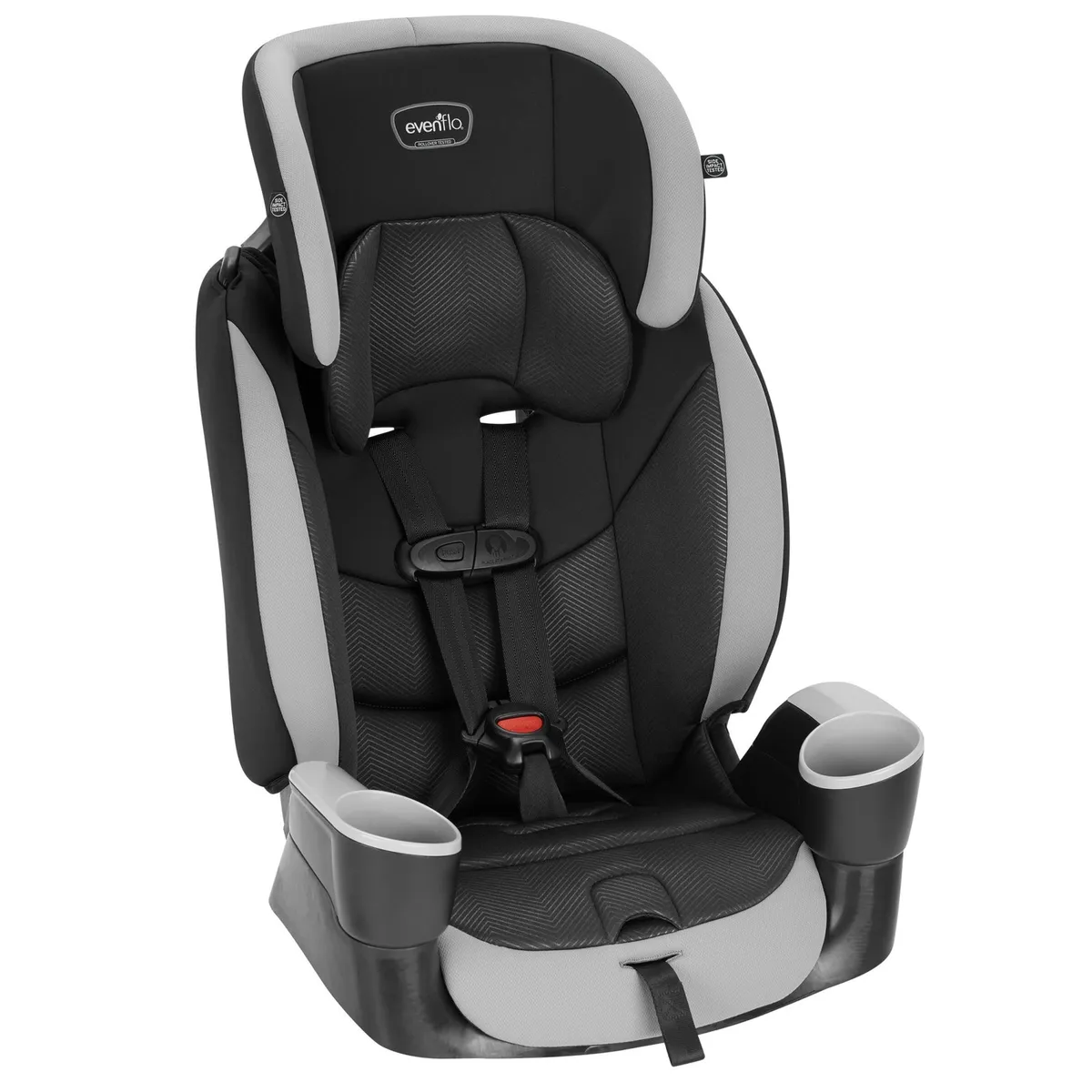
The Evenflo Maestro Sport is a light, budget, aircraft-certified harness seat for preschoolers that becomes a basic highback booster, but its 50 lb harness and fixed headrest mean many kids outgrow it early, so treat it as a travel or second-car seat rather than a do-everything booster.
- Forward-facing
- Booster
What we like
This is a light, simple harness seat that's easy to carry through an airport, and it's certified for aircraft in harness mode. The upfront harness adjuster tightens with one pull.
The lower anchors (LATCH) are rated to 50 pounds in harness mode, which covers the whole harness range, and Evenflo's RightFit belt path is designed to make seat-belt installs easier. The seat pad is machine washable and can be tumble dried on low.
Worth knowing
The harness stops at 50 pounds, and a child who outgrows it before age 5 can't move to booster mode in this seat. The headrest doesn't adjust and there's one shoulder-belt position, so booster mode is often outgrown about when the harness is.
The harness must be rethreaded to change height, testers found the hook-style lower-anchor connectors hard to remove, and on select models the cup holders need screws. At about 19 inches wide, it rarely fits three across.
❮ Return to Booster Seat Reviews
The Evenflo Maestro Sport is the seat a lot of families end up owning without making a big decision about it: it’s light, it’s in the budget band, and it’s certified for planes in harness mode. It starts as a forward-facing 5-point harness seat and later becomes a highback belt-positioning booster.
It won’t last as long as pricier harness-to-boosters, but as a travel seat, a second-car seat or the grandparents’ seat, it does the job simply.
Our verdict: a good, simple harness seat for a preschooler, and a short-lived booster. Every limit on this page comes from Evenflo’s current owner’s manual (document 257000048, dated 05/25).
What changed since our last review
Evenflo has revised the Maestro Sport, and the seat on shelves today has different limits from the one we first reviewed:
- Harness minimum: 22 lb → 30 lb. (Harness height is now 35–49 in.)
- Booster maximum: 110 lb → 100 lb. Booster height is still 44–57 in.
- Booster minimum age: 4 → 5 years.
- A new rule: if your child outgrows the harness before age 5, the manual says you must stop using the seat.
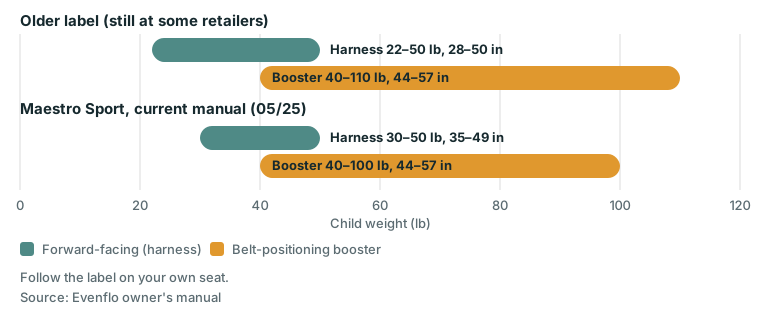
Two sets of limits on store shelves: check your label
Evenflo has revised the Maestro Sport’s limits. Earlier units are labeled for a 5-point harness from 22 to 50 lb and 28 to 50 in (at least 2 years), and booster use from 40 to 110 lb and 44 to 57 in (at least 4 years). Current units say 30–50 lb harness and 40–100 lb booster. Older units are still at some retailers. Always follow the label on your own seat and the manual that came with it.
Either way, a 22–30 lb child belongs rear-facing. Evenflo repeats the AAP’s advice to keep kids rear-facing as long as their seat allows (see our post on why rear-facing longer matters).
A correction to our earlier review
Our previous review described the original Evenflo Maestro in places, not the Maestro Sport. That older seat had different model numbers, colorways and measurements. We’ve removed:
- a “22–65 lb” harness range (no version of this seat harnesses past 50 lb)
- an IIHS “Best Bet” claim (it belonged to the original Maestro, and IIHS no longer rates boosters)
- a “Made in the USA” claim and a “2X the federal standard” testing claim we couldn’t confirm in the manual
- the 12 lb seat weight, the original Maestro’s slot measurements and colorways, and a “fits 3 across in small cars” claim
- a recall note that mixed up two original-Maestro recalls (corrected below)
- the statement that LATCH in booster mode was a rare extra; the manual says something more limited, covered under installation
What didn’t change: forward-facing only, fixed headrest, rethreaded harness, aircraft certification in harness mode only, and a limited 90-day warranty.
What are the child size limits of the Evenflo Maestro Sport?
| Mode | Weight | Height | Age | Fit rules |
|---|---|---|---|---|
| Forward-facing harness | 30–50 lb | 35–49 in | At least 2 | Tops of ears at or below the top of the headrest; straps at or slightly above the shoulders; chest clip at armpit level |
| Highback booster | 40–100 lb | 44–57 in | At least 5 | Tops of ears at or below the top of the headrest; shoulder belt midway between shoulder and neck; lap belt low across the hips |
Move to booster mode when your child is over 50 lb, over 49 in, or their shoulders are above the top harness slot, whichever comes first.
The age-5 rule is not optional. If your child outgrows the harness before age 5, the manual says you must stop using this seat. It can’t be used as a booster for an under-5, so you’d need a different harness seat.
Crotch buckle: keep the buckle strap in the slot closest to your child, never under them. From 40 lb, it must go in the front slot.
The honest catch: one fixed shoulder-belt position and a fixed headrest. CPST reviewers note booster mode is often outgrown about when the harness is. Measure often. For more on timing, see when it’s time to switch to a booster.
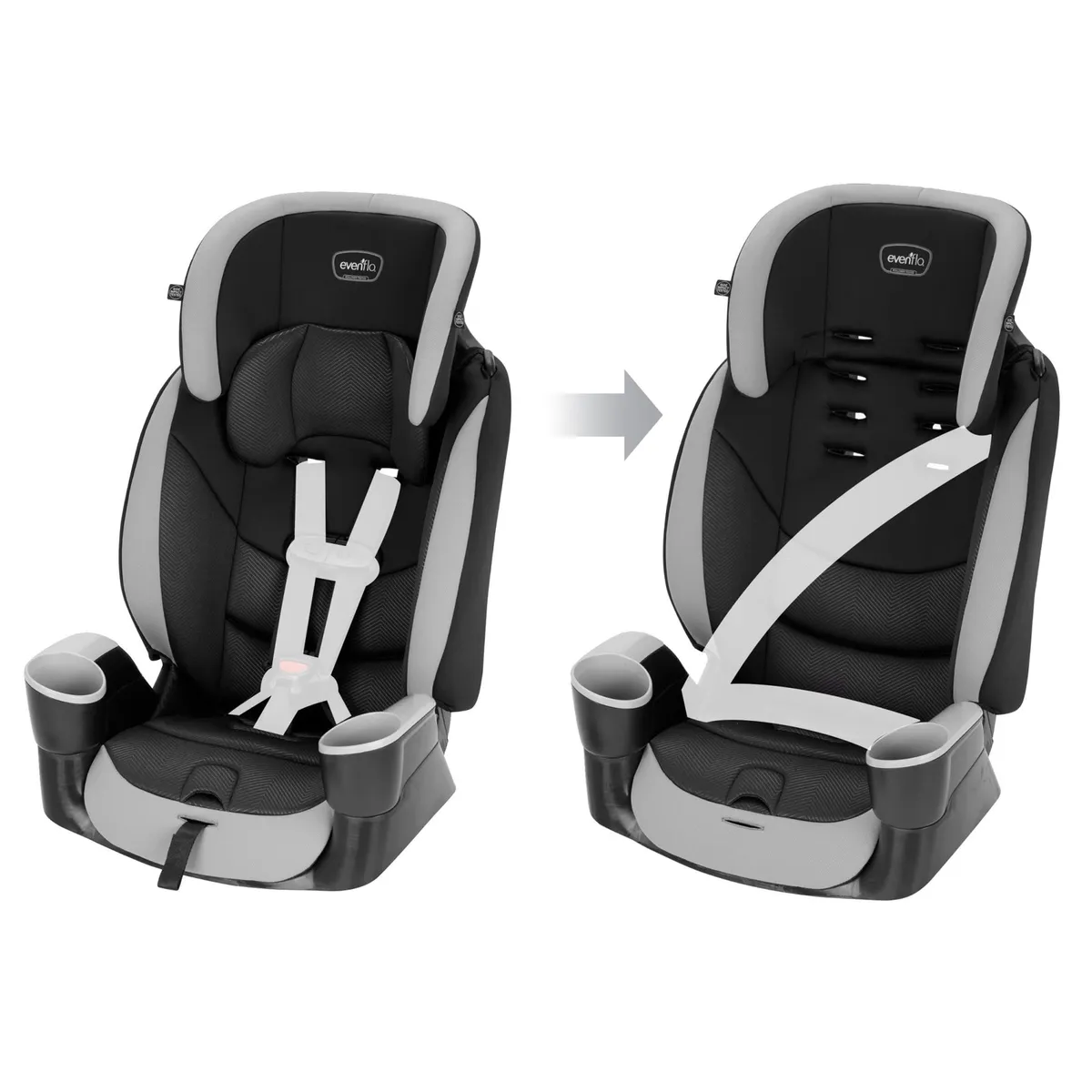
Image: Evenflo
How big is it, and will it fit in your vehicle?
It’s light: about 9–10 lb, per CPST measurements, which is why so many families travel with it.
It’s about 19 in wide at its widest point (shoulders and cup holders), per CPST measurements. That’s average, not slim: Safe in the Seat says three-across is unlikely except in large back seats. If you’re trying to fit three, see our three-across guide.
Check your vehicle headrest. The manual says to adjust or remove the vehicle headrest so the back of the Maestro Sport rests flat against the vehicle seat.
How safe is the Evenflo Maestro Sport?
According to the manual, the seat “meets all applicable requirements of the Federal Motor Vehicle Safety Standards.” Evenflo’s manual makes no separate side-impact claim. NHTSA’s new side-impact standard (FMVSS 213a), for seats used by children up to 40 lb, applies to seats manufactured on or after December 5, 2026, so check your seat’s label for what it was certified to.
BabyGearLab’s commissioned sled testing of an older-label unit in booster mode scored it among the lowest of the boosters it compared, all of which meet the federal standard. It’s one outlet’s result, but worth knowing.
What matters most is correct use: always tether in harness mode, with a snug harness and the chest clip at armpit level.
Recalls: what you need to know
Recall 25C-003 (registration card). In March 2025 Evenflo filed an NHTSA recall (amended April 2, 2025) covering 1,068 car seats that were made for the Canadian market but shipped to US customers. They came with a Canadian registration card that doesn’t meet the US federal requirement. Two Maestro Sport model numbers are included: 34912200C (Layton) and 34912258C (Crestone Peaks). Evenflo’s report says its testing found these seats met US performance requirements. The problem is the card, which could make it less likely that an owner registers the seat and hears about any future recall. Evenflo is mailing affected buyers a notice and a US registration card.
Check the date/model label on the back of your seat. If the model number ends in “C” and you bought it in the US, register it with Evenflo at 1-800-233-5921 or evenflo.com/registercarseat. You can look up recalls at nhtsa.gov/recalls or 1-888-327-4236.
Older recalls (original Maestro only): two older recalls, 10C-005 (2010, a possible crack near the harness adjuster, models starting 310 built Nov 24, 2009 – Apr 9, 2010) and 14C-003 (2014, a harness buckle that could become hard to unlatch, Maestro and Maestro Performance built Aug 22, 2011 – Oct 17, 2013), applied to the original Maestro, not the Maestro Sport. See our car seat recalls page for more.
How easy is it to install and use?
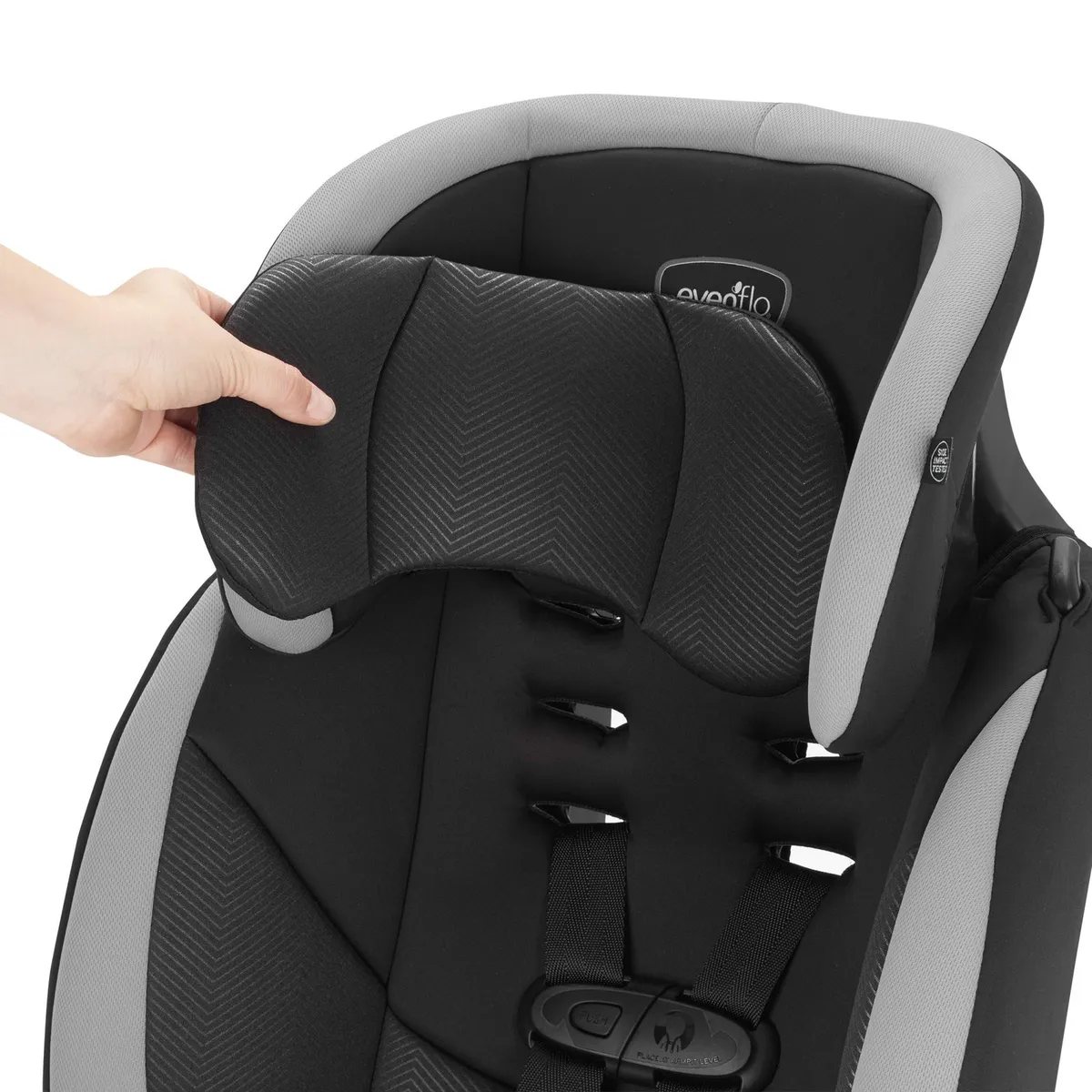
Image: Evenflo
Harness mode: install with the lower anchors (LATCH) or the vehicle seat belt, never both. Lower anchors are rated to 50 lb in harness mode, which covers the whole harness range. Either way, always use the top tether. The seat should move less than 1 in at the belt path.
- Evenflo’s RightFit belt path is meant to make seat-belt installs easier on the hands.
- In the center seat, borrow the inner lower anchors only if your vehicle manual allows it and they’re 11–20 in apart.
- No door-mounted, motorized or (in harness mode) inflatable belts. A locking clip or tether extender, if you need one, isn’t included; Evenflo’s ParentLink (1-800-233-5921) supplies them.
- Testers found the hook-style lower-anchor connectors hard to remove.
Booster mode: your vehicle’s lap-and-shoulder belt holds your child. Never use a lap-only belt, and don’t use a locking clip. The manual says you may clip the lower anchors on to keep the empty seat from flying forward in a crash, and that the booster must always be secured, by LATCH or the seat belt, when nobody’s sitting in it. The manual explains when to route the shoulder belt under the headrest and when to route it over the top.
Converting to booster means unthreading the harness and tucking it into the shell: a few minutes with the manual open.
Everyday use: the front harness adjuster tightens with one pull, but changing harness height means rethreading. On select models, the cup holders must be screwed on before first use, and the screws are easy to lose.
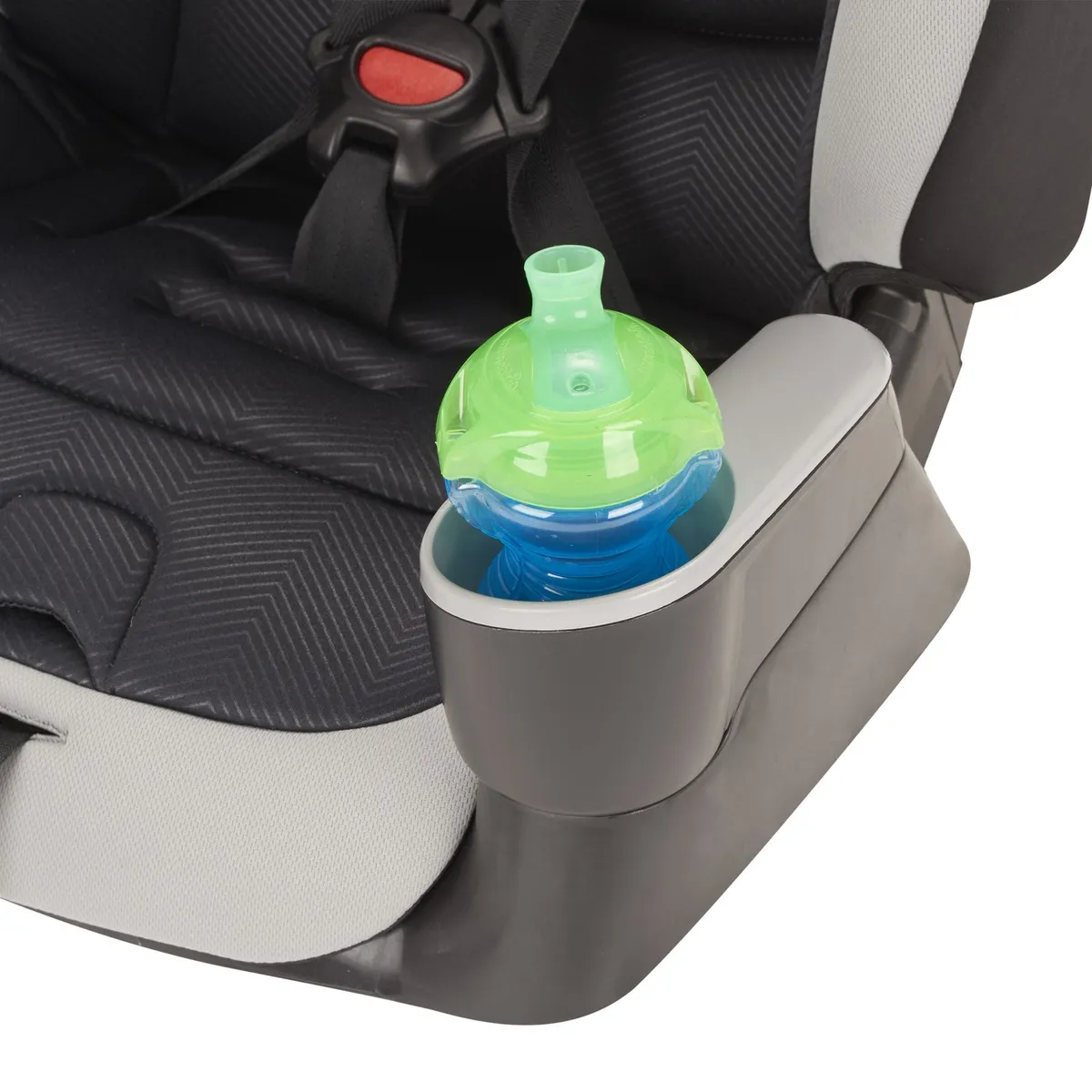
Image: Evenflo
Taking it on a plane
It’s certified for aircraft in harness mode only. Booster mode isn’t certified for planes, because aircraft have lap-only belts. At under 10 lb, it’s easy to carry through an airport. See our guide to flying with a car seat.
Cleaning and lifespan
The pad is machine washable (cold, delicate) and can be tumble dried 10–15 minutes on low. Surface-wash the harness only.
Evenflo’s manual says to stop using the seat after the expiration date printed on its date/model label. CPST sites list that as 6 years from the date of manufacture. The warranty is a limited 90 days for the original purchaser, with proof of purchase.
Evenflo Maestro Sport vs the alternatives
Graco Tranzitions 3-in-1: the “spend a bit more” pick, with a higher harness limit and an adjustable headrest.
Need to stay harnessed past 50 lb? Look for a harness booster rated to 65 lb, such as the Graco Tranzitions 3-in-1 above.
Evenflo Chase Plus: the same brand and price band, worth comparing side by side.
BestCarSeatHub’s Final Verdict

- Light (about 9–10 lb) and aircraft-certified in harness mode
- Budget price band
- Lower anchors usable for the whole harness range
- One-pull front harness adjuster
- Machine-washable pad

- Harness stops at 50 lb, and if your child outgrows it before 5 you must stop using the seat
- Fixed headrest and one belt position, so booster mode is often short-lived
- Harness must be rethreaded to change height
- Lower-anchor hooks are hard to remove
- Cup holders (select models) need screws
- Weak booster-mode result in one outlet’s sled test
- About 19 in wide, so rarely a three-across seat
Who it’s for
Families who want a light, simple, budget harness seat for a preschooler, especially for air travel, a second car or a grandparent’s car.
Who should skip it
- Parents of big or tall preschoolers. If your child may pass 50 lb or 49 in before 5, choose a seat with a higher harness limit.
- Anyone wanting one seat through the whole booster years. Booster mode tends to run out early.
- Three-across families with an average-size back seat.
For the right job, the Evenflo Maestro Sport is an easy, sensible pick. Use the buttons on this page to see current colorways, check the label on any seat you buy, and have your install checked by a certified car seat technician.
FAQ
What is the Evenflo Maestro Sport’s weight limit? Current units: 30–50 lb in the harness and 40–100 lb as a booster. Older units are labeled 22–50 lb and 40–110 lb. Follow the label on your seat.
Why does my Maestro Sport say 22 lb? You likely have an older-label unit. Its limits still apply to that seat, per its own label and manual.
Is it recalled? Two Maestro Sport model numbers ending in “C” are part of registration-card recall 25C-003. See the recall section above.
- Modes
- Forward-facing 5-point harness, then highback belt-positioning booster (no rear-facing, no backless mode)
- Forward-facing harness
- 30–50 lb, 35–49 in, at least 2 years old; tops of ears at or below the top of the headrest
- Booster
- 40–100 lb, 44–57 in, at least 5 years old; tops of ears at or below the top of the headrest; vehicle lap-and-shoulder belt only
- Outgrows the harness before age 5
- Stop using this seat (owner's manual)
- Move to booster mode
- Over 50 lb, over 49 in, or shoulders above the top harness slot
- Crotch buckle
- Front slot required from 40 lb
- Lower anchors (LATCH)
- To 50 lb in harness mode (the full harness range)
- Top tether
- Always, in harness mode
- FAA
- Certified for aircraft in harness mode only
- Seat weight
- About 9–10 lb (CPST measurements)
- Width
- About 19 in (CPST measurements)
- Useful life
- See the expiration date on the seat's label (6 years, per CPST sites)
- Warranty
- Limited 90-day
- Owner's manual
- 257000048 (05/25)